
What Size Binding Coil Do I Need? The 2026 Guide to Perfect Sizing
May 29th 2026

A binding coil that fits perfectly on a static stack of paper is often a failure once it reaches your client's hands. Most professionals select their supplies based on a simple sheet count, but that is the fastest way to end up with a document that resists being opened. If you are asking, "what size binding coil do I need," the answer lies in calculating the movement margin rather than just counting pages. You've likely experienced the frustration of a spiral that is too tight to turn or an oversized coil that makes a premium report look loose and unprofessional.
We believe that the quality of your assembly should reflect the quality of the work inside. This 2026 guide will teach you how to accurately measure your document thickness and select the perfect diameter for a functional, high-end finish. We'll cover the essential math behind binding margins and provide specific sizing charts for standard 4:1 pitch coils. By the end of this article, you'll have the confidence to choose the right supplies for your Akiles or Rhin-O-Tuff equipment, ensuring every page turns with ease and your documents open a full 360 degrees.
Key Takeaways
- Distinguish between internal coil diameter and hole pitch to ensure your binding supplies perfectly match your punching equipment specifications.
- Learn how to measure your total document stack height to accurately answer what size binding coil do I need for seamless page turning.
- Access our updated 2026 sizing chart to convert sheet counts into precise millimeter measurements for standard 20lb bond paper.
- Avoid the common "Too Small" trap by accounting for cover thickness and the necessary space for a professional crimped finish.
- Enhance your professional image by selecting tailored coil diameters that allow documents to lay flat and function reliably under heavy use.
Understanding Binding Coil Dimensions: Diameter vs. Pitch
Achieving a professional finish begins with mastering two distinct measurements: diameter and pitch. While many users focus solely on the question, "what size binding coil do I need," they often overlook that the size of the coil is irrelevant if the pitch doesn't match the punch pattern of their machine. Coil binding relies on a precise mechanical alignment where the spiral must thread perfectly through every hole in your document. If these two elements aren't synchronized, the assembly process will fail before it even starts.
Think of diameter as the volume capacity of your spine. It determines how many pages your document can hold while still allowing them to turn freely. Pitch, on the other hand, refers to the distance between the holes. If you attempt to use a 3:1 pitch coil in a document punched with a 4:1 pattern, the spiral will quickly become misaligned. This renders the coil unusable and can easily damage your printed materials. Understanding this distinction ensures you don't waste resources on incompatible supplies.
What is 4:1 Pitch?
The industry standard for plastic spiral binding is 4:1 pitch, which translates to four holes per linear inch. This specific spacing ensures that the document remains secure while maintaining maximum flexibility. High-performance machines like the Akiles CoilMac-M or the Rhin-O-Tuff Onyx HD7700 are engineered specifically for this 4:1 standard. While you might occasionally encounter 5:1 or 3:1 variants in specialized legacy projects, 4:1 remains the most reliable choice for modern professional presentations. Using the correct pitch provides several benefits:
- Smooth Threading: The coil glides through the holes without snagging.
- Structural Integrity: More holes per inch provide better support for the paper edges.
- Standardization: Easier to find replacement supplies and compatible covers.
Inside vs. Outside Diameter
When browsing for supplies, it's vital to remember that industry specifications always refer to the inside diameter (ID) of the coil. This is the clear space available for your paper stack to occupy. The outside diameter will always be slightly larger because of the thickness of the plastic filament itself. If you're restocking an existing supply and need to verify the size, measure the internal opening of the spiral with a ruler. This ensures you don't accidentally order a size too small by measuring from the outer edges of the plastic.
To accurately answer what size binding coil do I need, you must first confirm your equipment's pitch. Most professional-grade equipment will have the pitch clearly labeled on the casing or in the user manual. Once you've confirmed your pitch, you can focus on the specific thickness of your document stack to find the ideal diameter for a polished, functional result. This methodical approach removes the guesswork from your production process.
How to Measure Your Document for the Perfect Fit
Precision in measurement is the foundation of a high-quality bound document. To begin, gather your entire stack of paper, including all internal inserts and tabs. Place the document on a perfectly flat surface and compress it slightly with your hand to remove any trapped air between the sheets. Use a ruler to measure the total thickness of the stack from the bottom page to the top. While many guides suggest simply counting pages, this is often inaccurate because paper weights and densities vary significantly between brands. Measuring the physical height in inches or millimeters is the only way to accurately answer the question, "what size binding coil do I need" for your specific project.
Once you have this base measurement, you must account for the mechanical requirements of the spiral. A coil that matches your stack thickness exactly will pinch the paper; this makes it impossible to flip pages without tearing the punch holes. This is where the movement margin becomes critical for a professional finish. You want your document to feel substantial yet fluid in the hand, which requires a spine that accommodates the natural arc of the paper as it rotates.
The "Movement Margin" Rule
The movement margin is a standard industry practice that adds 1/8" (approximately 3mm) to your initial stack measurement. This extra space allows the pages to glide over the curves of the plastic spiral without resistance. Without this margin, the friction between the paper and the coil increases, leading to premature wear and a cluttered aesthetic. If your calculated total falls between two standard coil sizes, always round up to the larger diameter. Rounding up preserves the mechanical integrity of the bind while rounding down almost guarantees a document that is difficult to use.
Accounting for Covers and Inserts
Your choice of finishing materials significantly impacts the final diameter required. For instance, Clear Acetate Covers or heavy Regency Composition Covers add more bulk than several sheets of standard 20lb bond paper. Always measure your stack after these covers are in place. If your report includes laminated pages or thick cardstock dividers, these will also expand the stack height. Should you still be asking what size binding coil do I need after calculating these additions, consider that a slightly larger coil always looks more intentional than a cramped one. Selecting the correct Plastic Spiral Binding Coils based on the fully assembled thickness ensures your final product looks as professional as the work it contains.
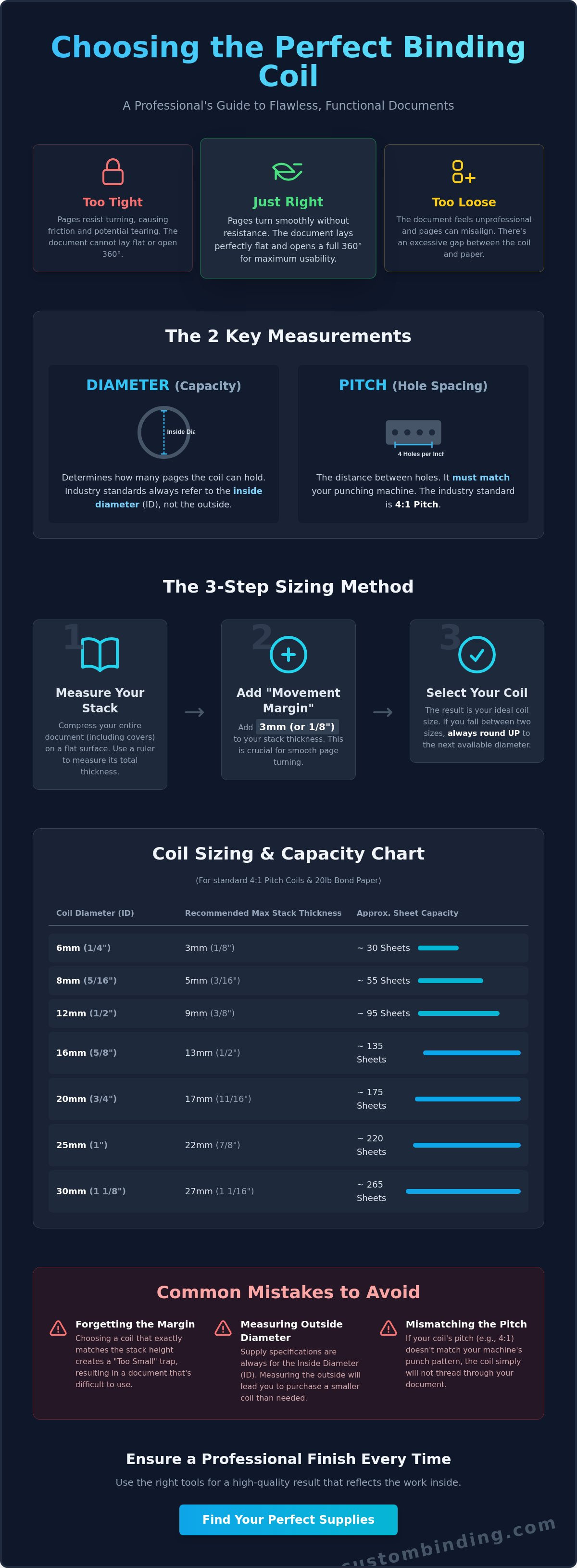
Coil Sizing Chart: Sheet Capacity vs. Diameter
Selecting the correct diameter is a balance between the physical volume of your paper and the mechanical needs of the spiral. Most generic sizing guides fail because they don't specify the paper weight used to calculate capacity. The data below is based on standard 20lb bond paper, which is the baseline for most professional reports. If you're using premium 24lb or 32lb stock, your sheet capacity will decrease by approximately 15% to 20%. When you're determining what size binding coil do I need, always account for these variations in paper density to avoid a cramped final product.
The most common office applications utilize coils ranging from 6mm to 20mm. These sizes provide a sleek, low-profile look for internal documents and client presentations. For massive technical manuals or archival records, standard coil binding can accommodate diameters up to 50mm (approximately 2 inches), which holds roughly 440 sheets of 20lb paper. Beyond this point, the weight of the document often requires specialized binding methods to maintain structural integrity.
Small to Medium Documents (Up to 100 Pages)
For thinner documents, precision is vital to prevent the coil from appearing oversized. A 6mm (1/4") coil is the industry standard for small booklets up to 30 sheets. If your stack grows to 50 sheets, transition to an 8mm (5/16") diameter. For documents approaching the 70-sheet mark, a 10mm (3/8") coil provides the necessary clearance. These smaller sizes are ideal for marketing materials where a compact, easy-to-handle feel is a priority. Using a coil that's too large for a 30-page document makes the spine look hollow and less professional.
Large Documents (100+ Pages)
As your page count increases, the curve of the coil must expand to allow the thicker stack to rotate. A 15mm (9/16") coil comfortably handles up to 120 sheets, while a 20mm (3/4") diameter is suitable for roughly 160 sheets. For substantial projects reaching 200 pages, select a 25mm (1") coil. When you ask what size binding coil do I need for these larger volumes, remember that the movement margin discussed earlier becomes even more important. The weight of 200 pages puts significant stress on the punch holes; a larger diameter reduces this tension by providing a more gradual curve for the paper to follow.
- 6mm (1/4"): 30 Sheets
- 8mm (5/16"): 50 Sheets
- 10mm (3/8"): 70 Sheets
- 12mm (1/2"): 90 Sheets
- 15mm (9/16"): 120 Sheets
- 20mm (3/4"): 160 Sheets
- 25mm (1"): 200 Sheets
- 32mm (1 1/4"): 250 Sheets
- 50mm (2"): 440 Sheets
Use these figures as a starting point. If your document includes several Regency Composition Covers or heavy cardstock dividers, choose the next size up from your measured sheet count. This proactive adjustment ensures your finished document functions perfectly from the first page to the last.
Common Mistakes When Choosing Binding Spines
Even with precise measurements, small oversights can compromise the durability of your project. The most frequent error is falling into the "Too Small" trap. When you ask "what size binding coil do I need" and select a diameter that barely fits the stack, you're prioritizing a tight profile over long-term functionality. This mistake leads to excessive friction that eventually tears the punch holes, especially near the covers. A professional bind should feel effortless to navigate, not like a struggle against the plastic filament. If the pages don't move freely, the document will eventually fail under normal use.
Another critical error is neglecting pitch compatibility. As established in our earlier discussion on dimensions, a 4:1 pitch machine requires a 4:1 pitch coil. Mixing brands or assuming all spirals are universal often results in a spine that starts correctly but becomes misaligned halfway through the document. Always verify that your Plastic Spiral Binding Coils match the specific hole pattern of your Akiles or Rhin-O-Tuff equipment before starting a large production run.
The Importance of the Crimping Tail
Standard coils for Letter-sized documents are typically 12 inches long, despite the paper being only 11 inches. This deliberate overlap provides the necessary material for the crimping tail. You must have approximately 1/2 inch of extra coil on each end to properly use crimping pliers. This mechanical step secures the spine in place, preventing the spiral from rotating out of the document during use. Without this extra length, you cannot achieve the secure, locked-in finish required for high-traffic manuals or client-facing reports. If you're working with larger formats, 36-inch coils can be trimmed to provide this same essential margin.
Color and Material Consistency
Aesthetics play a significant role in professional storytelling. While black is the industry default, matching your coil color to your Regency Composition Covers or back cardstock creates a more cohesive, tailored appearance. Custom Binding Products offers a wide variety of wholesale colors beyond basic black, allowing for brand-specific customization that sets your work apart. Additionally, consider the density of the plastic. Larger documents benefit from stiffer filaments that maintain their circular shape under the weight of the paper stack, while smaller booklets can use softer, more flexible materials without losing their form.
Ready to upgrade your finishing supplies? Shop our full selection of Plastic Spiral Binding Coils to find the perfect match for your next project.
Expert Binding Support for San Diego Professionals
Custom Binding Products brings over 30 years of specialized experience to the Southern California market. For many local businesses, determining "what size binding coil do I need" is just the first step in a larger production workflow. We provide on-site consultations for high-volume San Diego print shops to help streamline these processes and ensure every piece of equipment operates at peak efficiency. Our San Diego showroom offers a unique opportunity for professionals to conduct hands-on testing with industry leading machines before making a capital investment. This tactile experience ensures you select tools that match your specific volume and aesthetic requirements.
Our commitment to local partnerships goes beyond simple product sales. We understand that in the professional world, the physical quality of a document is a direct reflection of the brand that produced it. By offering localized support, we act as a steady hand in the busy environments of law firms, educational institutions, and marketing agencies across the county. This proximity allows us to solve mechanical challenges that generic online retailers simply can't address.
Why Local San Diego Support Matters
When a critical project deadline is hours away, waiting for a shipment from an out-of-state vendor isn't a viable option. Local pickup for urgent binding supplies removes the friction of transit times and eliminates the risk of shipping damage for fragile clear acetate covers. Beyond providing supplies, our team offers expert technical guidance on machine compatibility for brands like Akiles, Rhin-O-Tuff, and GBC. We also provide dedicated repair services for local equipment, ensuring your production line stays active even when mechanical issues arise. This reliability is why San Diego professionals have trusted us for three decades.
Custom Solutions for Your Brand
Creative projects in San Diego often require more than off the shelf solutions. If you're working with non-standard dimensions or unique materials, our team can provide custom length coils tailored to your specific vision. We encourage you to contact us for a personalized sizing recommendation if you remain unsure about your stack measurements after reviewing our guides. To maintain a consistent professional image, consider our recurring supply program. This service ensures your office inventory of plastic spiral binding coils and Regency composition covers remains stocked, allowing you to focus on the content of your work while we handle the logistics of the finish. This methodical approach to inventory management prevents the last minute panic of an empty supply closet.
Master Your Professional Presentation
Selecting the right spine is a mechanical decision that defines the tactile experience of your work. By prioritizing the 1/8" movement margin and verifying your equipment's pitch, you transform a stack of paper into a durable, functional tool. Mastering these technical specifications ensures you'll never have to ask what size binding coil do I need for a high-stakes report again. Remember that accounting for the crimping tail and choosing the correct plastic density are the final steps in achieving a polished, executive finish.
Since 1988, we've served the San Diego community as a trusted partner in document finishing. As an authorized dealer for industry leaders like Akiles and Rhin-O-Tuff, we combine technical expertise with local reliability. Whether you need to test equipment in our San Diego showroom or require expert repair services, our team is here to support your professional success. Take the guesswork out of your production process and invest in supplies that reflect your commitment to quality.
Browse Our Professional Plastic Coil Supplies today and start creating documents that leave a lasting impression.
Frequently Asked Questions
Is coil binding better than wire or comb binding for large books?
Coil binding is often superior for large books because it offers exceptional durability and allows for full 360-degree page rotation. While Twin Loop Binding Wire provides a premium metal finish, plastic coils are resilient to crushing and can handle documents up to 50mm in thickness. This makes them the ideal choice for heavy technical manuals or reference guides that experience frequent handling in busy professional environments.
Can I use a 3:1 pitch coil with a 4:1 pitch binding machine?
No, you cannot mix pitch sizes because the holes and the spiral loops will not align. A 4:1 pitch machine, such as the Akiles CoilMac-M, punches four holes per inch and requires a matching 4:1 plastic coil. Attempting to use the wrong pitch will cause the spiral to snag or bind; this ultimately ruins your document and puts unnecessary stress on your machine's insertion rollers.
What happens if I use a coil that is too large for my document?
Using an oversized coil results in a loose, unprofessional appearance where the pages shift excessively within the spine. While a larger size prevents pages from binding up, it makes the document feel flimsy and difficult to stack or file. To avoid this, use the measurement techniques described earlier to answer what size binding coil do I need and select a diameter approximately 1/8" larger than your stack.
Do I need special tools to finish a coil-bound book?
Yes, you need a pair of coil crimping pliers to cut and bend the ends of the plastic filament. This essential step prevents the coil from spinning out of the holes during use. While electric inserters on high-volume machines like the Rhin-O-Tuff Onyx HD7700 automate the threading process, the final crimp must be performed manually to lock the spine in place and ensure a secure, permanent bind.
How do I determine the sheet capacity if I use heavy cardstock?
You should measure the total physical height of the stack in millimeters rather than relying on sheet counts. Heavy cardstock or Regency Composition Covers are significantly thicker than standard 20lb bond paper. If your assembled stack measures 12mm, add the 3mm movement margin to reach a 15mm requirement. This physical measurement is the most reliable way to determine what size binding coil do I need for non-standard materials.
Are plastic coils available in different lengths for legal or A4 paper?
Yes, plastic coils are manufactured in various lengths to accommodate different document formats. While 12-inch coils are the standard for 11-inch Letter-sized paper, we also provide 36-inch lengths that can be trimmed for Legal (14") or custom creative projects. This flexibility ensures you always have the necessary 1/2-inch tail on each end for a secure crimp, regardless of the document's height or orientation.
Can I reuse a plastic coil if I need to update the document?
You can technically reuse a plastic coil, but you must first trim off the crimped ends to thread it out of the holes. This process shortens the filament, which may make it too short to be properly crimped again on a document of the same size. For a professional result, we recommend using a fresh coil when updating reports to ensure the spine remains secure and the ends are properly locked.
Where can I buy binding coils in San Diego for same-day pickup?
You can purchase professional-grade supplies directly from our San Diego showroom and warehouse. We maintain an extensive inventory of Plastic Spiral Binding Coils and Regency Composition Covers for local professionals who need to bypass shipping delays. Visiting our local facility also allows you to consult with our specialists regarding machine compatibility or to view our full range of Dahle trimmers and Martin Yale folders.