
Coil Binding vs. Wire Binding: Choosing the Professional Edge for 2026
Jun 24th 2026
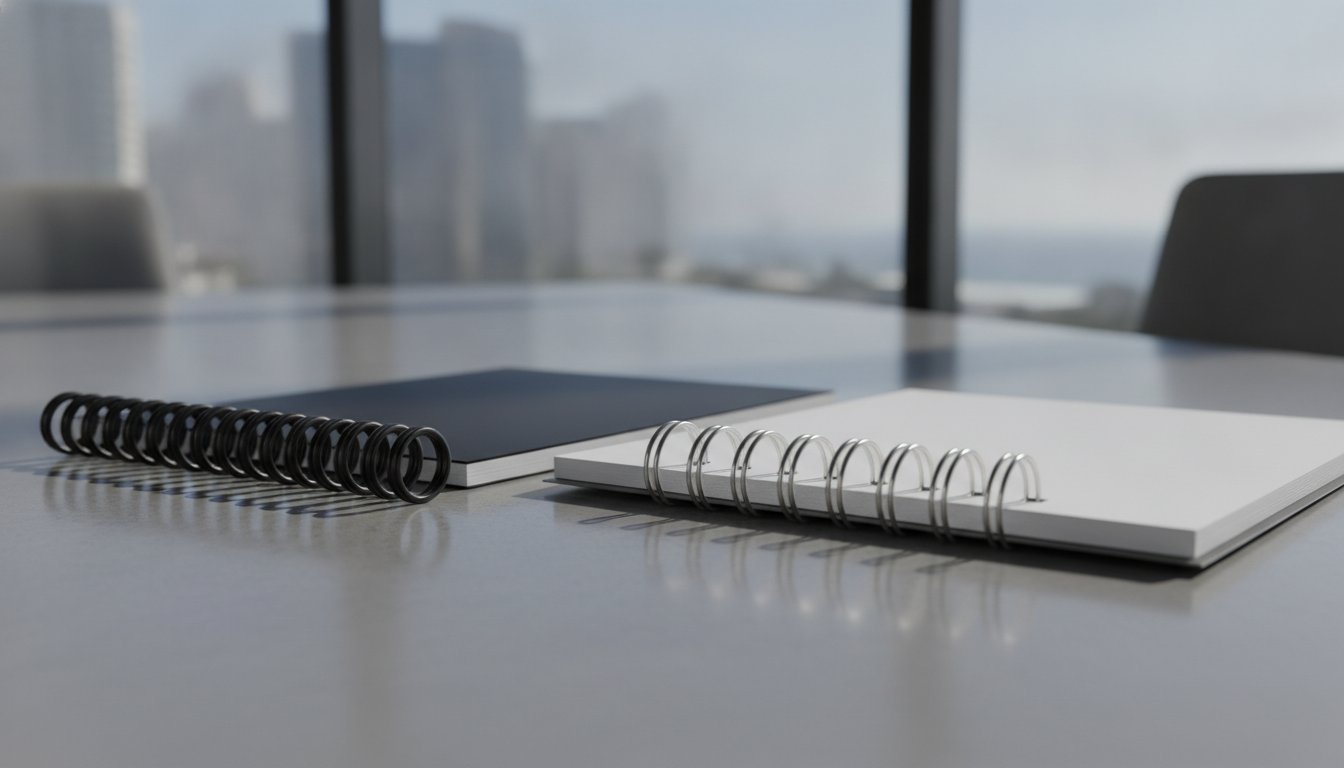
Your client's first impression of your work happens before they read a single word. It happens the moment they feel the weight of the paper and the tension of the spine. You've likely felt the frustration of a high-stakes presentation looking unpolished or, worse, a manual that begins to shed pages after a week of heavy use. Choosing between coil binding vs wire binding isn't just a matter of utility; it's a strategic decision that reflects your brand's commitment to excellence and durability.
We understand that navigating technical specifications like pitch and hole compatibility can feel like a distraction from your core business goals. This article provides a clear roadmap to help you distinguish between these two popular methods. You'll discover how the 360-degree rotation of plastic coils compares to the sophisticated, flat-laying finish of twin-loop wire. We also analyze how 2026's projected 15% to 35% increase in steel prices should influence your supply management. By the end of this guide, you'll have the technical expertise to produce documents that aren't just organized, but are essential tools for professional storytelling.
Key Takeaways
- Contrast the mechanical structures of continuous spirals and twin-loop metal spines to ensure your document functions exactly as intended.
- Evaluate the trade-offs between the crush-resistant durability of plastic and the premium "executive" aesthetic of metal wire for high-stakes presentations.
- Navigate the choice of coil binding vs wire binding by matching your project’s page count to the specific capacity limits of each binding method.
- Avoid costly assembly errors and supply waste by mastering the critical relationship between punch patterns and binding pitch.
- Discover how local authorized sales and service for professional systems like the Akiles CoilMac-M or Rhin-O-Tuff Onyx HD7700 protect your long-term equipment investment.
Understanding the Mechanics: Coil vs. Wire-O Binding
The decision between coil binding vs wire binding begins with a fundamental understanding of how these two elements interact with paper. While both methods result in a document that can lay flat, the mechanical path to that finished product is entirely different. Plastic spiral binding utilizes a continuous, spring-like coil that threads through a series of round holes. In contrast, twin loop wire binding involves individual "C" shaped metal loops that are inserted into square or rectangular holes and then compressed into a permanent circle. This mechanical distinction dictates your choice of equipment and the specific punch pattern required for your project.
Threading a coil is a dynamic process where the spine rotates into place, whereas wire binding is a static compression process. Because the hole patterns are not interchangeable, your hardware must match your desired finish. For instance, a heavy-duty punch like the Rhin-O-Tuff Onyx HD7700 can be configured with interchangeable dies to handle both, but the specific die used for a coil project will never work for a wire document. Selecting the wrong method at the start of your workflow can lead to wasted materials and significant delays.
The Anatomy of Plastic Spiral Coil
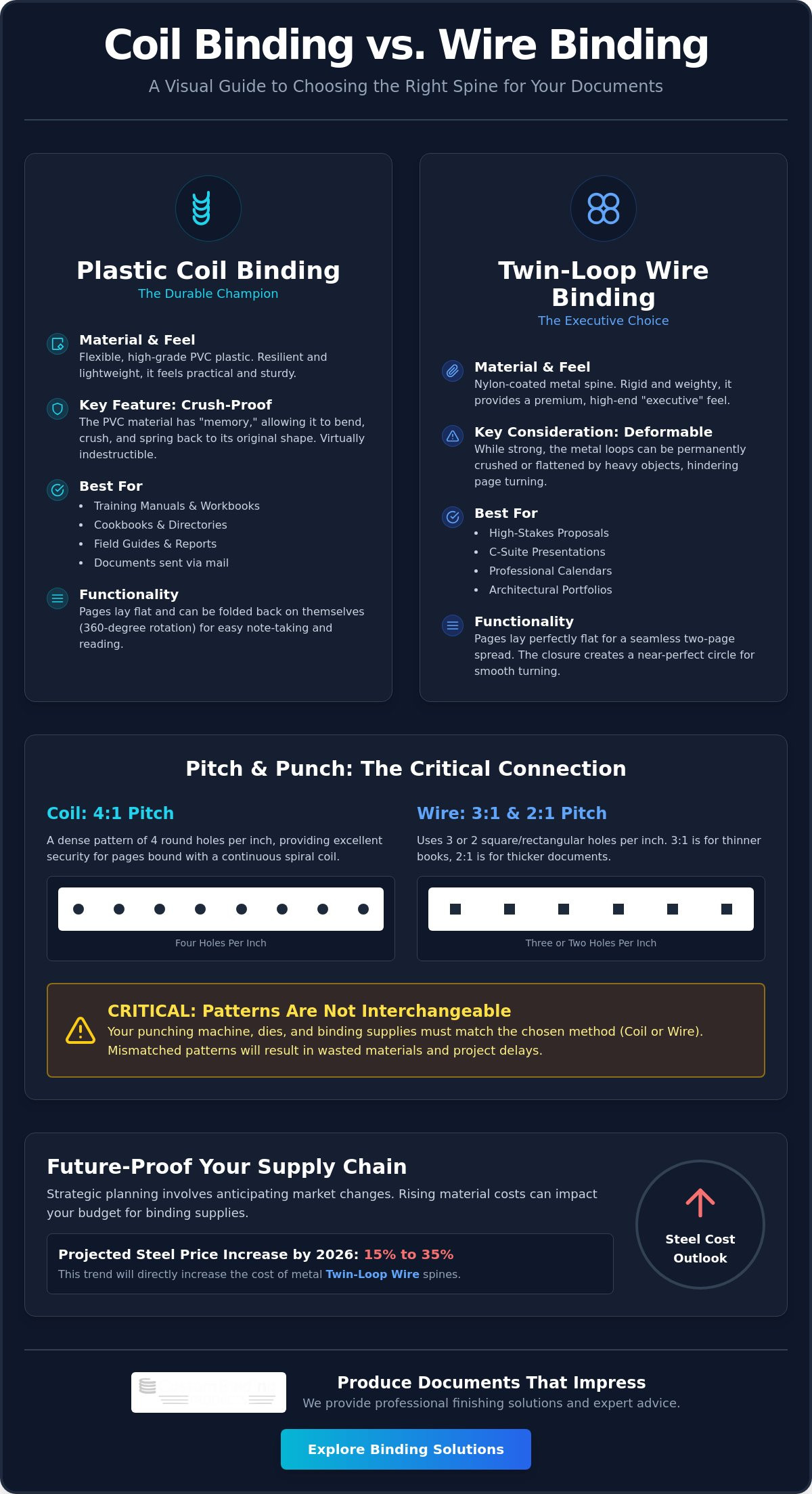
Plastic spiral coils are manufactured from high-grade PVC that is designed for maximum resilience. This material is uniquely durable because it retains its shape even after being crushed or bent; it simply bounces back to its original form. The industry standard for these coils is a 4:1 pitch, which means there are four holes per inch of paper. This dense hole pattern provides excellent security for the pages. To finish a coil-bound document, you must use specialized pliers to crimp the ends of the PVC. This small mechanical fold prevents the coil from unthreading during use, ensuring the document remains intact through years of handling.
The Structure of Twin Loop Wire
Twin loop wire binding, often referred to as Wire-O, offers a sophisticated aesthetic by using nylon-coated metal spines. These spines provide a heavy-duty feel that signals quality and permanence. The Wire-O binding mechanics rely on a specific pitch to accommodate different document thicknesses. Typically, a 3:1 pitch (three holes per inch) is used for documents up to 9/16 of an inch, while a 2:1 pitch (two holes per inch) is reserved for thicker books. Once the wire is placed through the holes, a "Wire Closer" mechanism on a machine like the Akiles CoilMac-M or a dedicated closer applies even pressure to the loops. This compression creates a perfect circle, allowing pages to turn seamlessly without catching on the metal edges.
Performance and Durability: Which Spine Holds Up?
The physical environment where your document lives determines its lifespan. When evaluating coil binding vs wire binding for long-term performance, you must consider how the materials respond to pressure and repetitive handling. While both systems provide a secure finish, their mechanical resilience varies significantly under stress. Understanding the sheet capacity for coil and wire binding is a useful starting point, but the material's reaction to everyday friction is what truly defines its value.
Plastic coil is the undisputed leader for documents that endure heavy travel or mailing. Because the PVC material possesses "memory," it can be crushed or compressed and will immediately return to its original shape. This makes it ideal for training manuals or field guides that are frequently stuffed into laptop bags or sent through the postal service. Conversely, twin loop wire is a metal-based solution. While it offers a rigid and premium feel, it's susceptible to permanent deformation. If a heavy object is stacked on a wire-bound report, the loops can flatten, which prevents pages from turning smoothly and can eventually lead to the document falling apart.
Resilience in High-Traffic Environments
Manuals, cookbooks, and instructional guides require a spine that doesn't just hold pages together but survives constant interaction. Plastic spiral binding is the preferred choice here because it's virtually indestructible in mobile work environments. The flexibility of the PVC allows the document to absorb impact without the spine catching or snapping. If you're producing high-volume internal documents that will be handled by multiple team members, choosing a durable plastic coil ensures the document remains functional until the next update. High-performance equipment like the Rhin-O-Tuff Onyx HD7700 makes it easy to switch between these materials depending on your project's durability requirements.
The 360-Degree Rotation Advantage
Both coil and wire binding offer a 360-degree rotation, allowing the user to fold the document back on itself. This is a critical functional benefit for note-taking and photocopying that traditional comb binding simply can't match. Wire binding provides a slightly smoother page-turn experience because the twin-loop design creates less friction against the paper. However, as the spine diameter increases for thicker documents, the rotation in a wire-bound book can become tighter. Coil binding maintains a consistent, fluid motion regardless of the document's thickness. If you're looking for the right balance of aesthetics and function, the team at Custom Binding Products can help you select the ideal supplies for your specific document type.
Page security is another factor where these two methods differ. In a coil-bound book, the continuous spiral makes it nearly impossible for pages to "walk" out of the spine. In wire binding, if the loops aren't closed with precision using a machine like the Akiles CoilMac-M, a small gap can remain. Over time, pages may slip through this gap, compromising the integrity of your presentation. Precision in the finishing stage is what separates a generic document from a professional asset.
Aesthetic Impact: Aligning Binding Style with Professional Identity
The aesthetic choice between coil binding vs wire binding serves as a silent ambassador for your brand. While previous sections focused on mechanical durability, the visual and tactile feedback of a document often carries more weight in a boardroom. A document's finish is a physical extension of your professional reputation. Wire binding, with its nylon-coated metal loops, projects a sense of permanence and prestige. In contrast, plastic coil offers a modern, accessible, and highly customizable utility that reflects organized efficiency.
According to the University of Akron binding guide, both methods are primary examples of mechanical binding, yet they occupy very different spaces in the professional hierarchy. The psychological impact of metal against a reader's hand shouldn't be underestimated. It feels substantial. It feels like an investment. When an executive picks up a document, the tactile rigidity of a metal spine communicates that the contents are definitive and high-value.
Wire Binding for High-Stakes Presentations
In San Diego’s competitive financial and legal sectors, the "Wire-O" finish is the gold standard for board decks and legal briefs. Its clean, geometric lines create a sophisticated profile that pairs perfectly with Clear Acetate Covers or high-end Regency Composition Covers. This combination delivers a modern, architectural look that suggests the information within is both authoritative and polished. Unlike plastic, the metal loops of twin-loop wire suggest a document intended for long-term reference or a final proposal that requires a formal, executive "edge."
Coil Binding for Internal Manuals and Creative Portfolios
For creative agencies and biotech research labs in San Diego, the flexibility of plastic coil is often the superior choice. With over 40 colors available, businesses can use the spine as a categorization tool for internal training modules or specific research phases. This color versatility allows for precise branding consistency, ensuring the document aligns perfectly with a corporate identity. The aesthetic is friendly and approachable. It invites the user to engage with the document and use it as a working tool. Creative portfolios benefit from this accessible look, as it highlights the craftsmanship of the work without the rigid formality of metal. By matching the spine color to your brand's palette, you transform a utility item into a tailored solution that reinforces your professional identity.
Technical Selection: Pitch, Page Count, and Material Limits
The mechanical feasibility of your project often dictates the choice between coil binding vs wire binding. While aesthetic preference matters, the physical volume of your document and the specific hole pattern of your equipment create hard boundaries. Understanding these technical constraints ensures you don't commit to a binding style that your hardware or material limits cannot support. Selecting the wrong pitch or spine size leads to jammed pages and wasted inventory.
Understanding Pitch and Hole Patterns
The "pitch" refers to the number of holes punched per inch of paper. This measurement is the most common source of error in document finishing. For standard letter-size documents with an 11-inch binding edge, the math is precise:
- 3:1 Pitch Wire: Requires 32 holes.
- 2:1 Pitch Wire: Requires 21 or 22 holes.
- 4:1 Pitch Coil: Requires 44 holes.
Attempting to force a 4:1 coil into a 3:1 punched document is physically impossible. Modular punching systems provide the most professional flexibility for growing businesses. The Rhin-O-Tuff Onyx HD7700 solves the "pitch problem" by allowing users to swap out interchangeable dies in seconds. This allows a single machine to transition from a coil pattern to a wire pattern without requiring a second investment in hardware. For those using fixed-die machines like the Akiles CoilMac-M, you must verify that your supply inventory matches the machine's factory-set pitch before beginning a high-volume run.
Capacity and Thickness Constraints
Document thickness is the final arbiter of your binding method. Plastic coil is the superior choice for high-capacity documents, as it can comfortably accommodate stacks up to 2 inches thick. Twin loop wire typically reaches its functional limit at 1-1/4 inches. Exceeding these limits causes the pages to bind against the spine, preventing the document from opening fully or laying flat.
Professional assembly requires the "Step-Up" rule: always select a spine diameter that is at least 1/8 inch larger than your total document stack, including covers. This clearance provides the necessary room for pages to rotate without friction. If you use a coil that is too large for a thin document, the book will feel flimsy and the pages may shift unevenly. The relationship between spine diameter and document wrap determines the fluid movement of every page for optimal functionality. High-volume production also requires an electric punch like the Tamerica Optimus-450 to maintain speed without motor fatigue. For expert guidance on matching your equipment to your production volume, consult with the specialists at Custom Binding Products to find a tailored solution.
Professional Finishing Solutions in San Diego
Your decision between coil binding vs wire binding shouldn't be a guessing game. Since 1988, Custom Binding Products has served as a dedicated partner for San Diego's professional community. We provide the technical expertise and inventory depth that national e-commerce retailers simply cannot match. Investing in a sophisticated system like the Akiles CoilMac-M or a Rhin-O-Tuff Onyx HD7700 is a commitment to your brand's future. When you source your equipment locally, you secure a superior long-term ROI through authorized sales and on-site technical support.
San Diego Industry Recommendations
Different sectors in our region have distinct document requirements. For the legal and financial firms in Downtown San Diego, we consistently recommend twin loop wire systems. The Wire-O finish provides a level of prestige and permanence essential for high-stakes litigation and formal client reporting. In Sorrento Valley's biotech and research facilities, plastic spiral coil remains the workhorse. Its resilience in lab environments and ability to lay flat during heavy data entry make it the practical choice for Sorrento Valley's fast-paced research cycles. Local creative and marketing agencies often prefer the customization of colored coils paired with Regency Composition Covers to create a tactile experience that stands out in a crowded marketplace.
Investment in Continuity
A production line that stops is a liability. We maintain a staff of San Diego-based technicians who understand the mechanics of your equipment. Whether you need a routine calibration or a critical repair, our on-site support keeps your operations moving. We also offer tailored supply programs for wholesale plastic coil and twin loop wire. Having these materials available for immediate local pickup eliminates the risk of shipping delays and allows you to manage your inventory with precision. This methodical approach to supply management prevents the preparation friction that often slows down a busy office.
We invite you to visit our San Diego facility to test different binding methods before you commit to a purchase. Feeling the tactile difference between a 4:1 plastic coil and a 3:1 metal wire helps you make an informed decision that reflects your quality standards. Our goal is to provide the steady hand you need in a busy professional environment. Explore our full range of binding machines and supplies to find the professional edge your documents deserve.
Elevate Your Professional Presentation Standards
Your choice in finishing equipment is an investment in your brand's tactile identity. Selecting between coil binding vs wire binding requires a balance of mechanical understanding and aesthetic intent. You now have the tools to distinguish between the indestructible nature of plastic spirals and the executive prestige of twin-loop wire. By prioritizing technical compatibility and material resilience, you ensure that every document leaving your office projects organized efficiency and craftsmanship.
Custom Binding Products has served as a steady hand for San Diego businesses since 1988. As a factory-authorized dealer for industry leaders like Akiles and Rhin-O-Tuff, we provide more than just hardware. It's a partnership in your professional success. Our local facility maintains a deep inventory of coils, wires, and covers for immediate pickup, which removes the friction from your daily preparation tasks. Take the next step in refining your document strategy today. Request a Professional Binding Consultation to find a tailored solution that reflects the quality of your work.
Frequently Asked Questions
Which is more expensive: coil binding or wire binding?
Wire binding typically carries a higher per-unit cost than plastic coil. This is driven by the material cost of nylon-coated metal and the impact of 2026 trade policies on steel prices. For high-volume production, plastic spiral binding coils remain the more cost-effective choice for supply management. The choice between coil binding vs wire binding should weigh this cost against the specific aesthetic requirements of your project.
Can I use the same machine for both coil and wire binding?
Most standard machines are dedicated to a single binding method, but modular systems provide an exception. Hardware like the Rhin-O-Tuff Onyx HD7700 allows you to swap punching dies for different hole patterns. However, you will still need a separate "closer" for wire and "pliers" for coil. Most entry-level machines like the Akiles CoilMac-M are fixed-die and cannot be converted between methods.
What is the most durable binding method for documents that are mailed?
Plastic coil is the most durable method for documents sent through the mail. Its PVC composition allows it to be compressed or crushed during transit and immediately return to its original shape. Metal wire binding can permanently deform if handled roughly by postal equipment, which prevents pages from turning. For manuals or field guides that face heavy travel, the resilience of plastic is the professional choice.
Is wire binding the same as spiral binding?
These terms are often confused, but they refer to different mechanical structures. "Spiral binding" almost always refers to continuous plastic coils that thread through round holes. Wire binding, or Wire-O, uses a series of twin metal loops that are clamped shut. While both allow the document to lay flat, the tactile feel and visual impact of metal loops are much more formal than the spring-like look of a spiral.
How do I choose between 3:1 and 2:1 pitch for wire binding?
Your document's thickness determines the pitch. Use 3:1 pitch (three holes per inch) for documents up to 9/16 of an inch thick. This tighter hole pattern offers a refined look for reports. For thicker documents between 5/8 of an inch and 1-1/4 inches, 2:1 pitch is the standard. Choosing the correct pitch ensures the pages have enough room to rotate around the metal spine without catching or tearing.
Can pages be added or removed from a wire-bound document?
Wire binding is a permanent finishing method. Once the metal loops are compressed into a circle, they cannot be opened without destroying the spine. If you need to add or remove pages, you must cut the wire away and bind the document again with a new spine. For projects that require frequent updates, plastic coil is easier to unthread and replace compared to the fixed nature of twin loop wire.
What are the best binding covers to use with metal twin loop wire?
Clear Acetate Covers and Regency Composition Covers provide the best aesthetic match for metal twin loop wire. The transparent acetate allows your title page to shine, while the leather-like texture of Regency covers complements the "executive" feel of the metal. This combination is the industry standard for board decks and legal proposals. It creates a rigid, high-value presentation that reflects the quality of the work contained within.
Where can I get binding machine repair in San Diego?
Custom Binding Products provides factory-authorized repair and maintenance services throughout San Diego. Our local technicians have supported the regional business community since 1988, specializing in brands like Akiles, Rhin-O-Tuff, and Tamerica. Buying your equipment locally ensures you have immediate access to on-site support and replacement parts. This proximity keeps your production line moving and protects your long-term investment in professional finishing hardware.