
Best Binding Method for Professional Reports: A 2026 Executive Guide
Jun 25th 2026

The physical feel of your document often speaks louder than the data on the page. In a high-stakes boardroom, a report that falls apart or refuses to lie flat doesn't just frustrate the reader; it subtly undermines your authority. Selecting the best binding method for professional reports is about more than just holding pages together. It's a strategic decision to ensure your presentation's tactile quality matches its intellectual depth. When the finish looks cheap, your hard work feels temporary rather than essential.
It's frustrating when a high-value proposal loses its impact because of a flimsy finish or a cover that won't stay open during a meeting. You deserve a streamlined process that delivers a polished, executive result every time. This guide will show you how to elevate your documents into durable, premium brand assets using professional in-house solutions. We'll preview the specific benefits of equipment like the Akiles CoilMac-M and GBC CombBind C800pro, comparing everything from high-capacity strip binding to the sleek aesthetics of twin loop wire. By the end, you'll have the confidence to choose a finish that commands respect before the first page is even turned.
Key Takeaways
- Understand how the mechanical assembly of your document influences reader perception and serves as an immediate indicator of work quality.
- Identify the best binding method for professional reports by evaluating the specific functional benefits of Twin Loop Wire, Plastic Spiral Binding Coils, and traditional combs.
- Learn to match binding diameters and materials to your document’s page count to achieve a flush, secure finish that withstands heavy use.
- Explore how finishing touches, such as Regency Composition Covers and clear acetate, provide both physical protection and a premium aesthetic.
- Discover how to scale your document production by implementing professional in-house equipment like the Rhin-O-Tuff Onyx HD7700 or Akiles CoilMac-M.
Why Binding Choice is the 'Tactile Handshake' of Your Professional Report
Professional document binding isn't just a finishing step; it's the mechanical assembly of your data into a secure, branded unit. While a standard office staple might suffice for internal memos, it fails in executive settings. Staples suggest a lack of permanence and a disregard for the reader's experience. In contrast, choosing the best binding method for professional reports signals that the information within is an investment worth protecting. It transforms a loose collection of pages into a singular, authoritative object.
Before a client reads a single word, they feel the weight of the document and the smooth rotation of the pages. This tactile experience creates an immediate psychological anchor. High-quality modern bookbinding methods ensure that reference manuals and archives maintain their integrity for years. Durability isn't a luxury; it's a requirement for work that needs to be consulted frequently without falling apart. A secure bind prevents the frustration of loose pages and ensures your intellectual property remains organized and intact during transit.
The Business Case for High-Quality Document Finishing
Polished presentation supports your corporate identity by reflecting the precision of your operations. In San Diego's competitive business environment, a cheap finish can lead to lost proposals and diminished authority. If your physical document looks rushed, clients may assume your intellectual work was too. Investing in professional covers, like Regency Composition Covers, transforms a stack of paper into a high-stakes professional statement. It's a small mechanical detail that yields a significant return in perceived value.
In-House vs. Outsourced Binding: A 2026 Efficiency Analysis
Bringing professional binding equipment into your local office offers a clear ROI by eliminating the delays and costs of external vendors. An in-house document center allows for on-demand production, which is critical for meeting tight deadlines before high-stakes meetings. Security is another vital factor. By binding documents within your own facility using a Rhin-O-Tuff Onyx HD7700 or Akiles CoilMac-M, you maintain total control over sensitive data and proprietary information. This streamlined process removes friction and ensures the final aesthetic always matches your brand's standards.
The 'Big Three' Binding Methods for Modern Business Reports
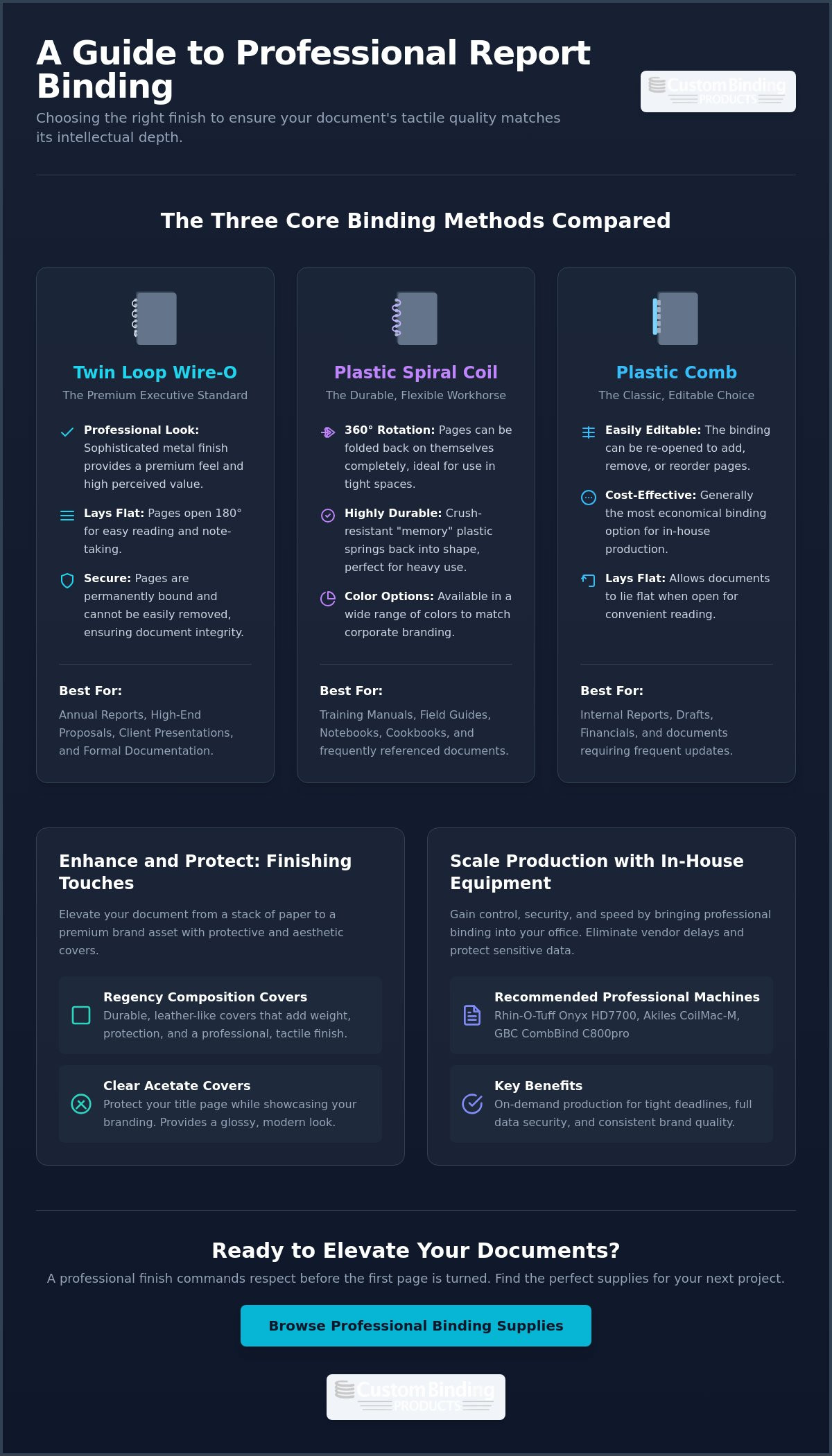
Choosing the best binding method for professional reports requires a balance between aesthetic appeal and functional utility. While many options exist, the industry relies on three primary mechanical standards: Twin Loop Wire, Plastic Spiral Coil, and Plastic Comb. Each method addresses specific use cases, from high-stakes board presentations to rugged field manuals. A critical technical detail involves matching the binding diameter to your precise page count. An oversized element feels loose and unpolished, while an undersized one prevents the pages from turning smoothly. Achieving a flush, professional finish starts with this measurement.
Functionality is just as important as looks. For reports intended to be read at a desk, lay-flat functionality is non-negotiable. Readers shouldn't have to fight the document to keep it open. Additionally, the color of the binding element offers a subtle branding opportunity. Moving beyond standard black or white to match your company’s visual palette reinforces corporate identity at every touchpoint. If you're looking to upgrade your presentation, you can browse professional binding supplies to find the perfect match for your brand colors.
Twin Loop Wire-O: The Premium Executive Standard
Twin Loop Wire-O is the preferred choice for annual reports and high-end proposals because it projects a sense of permanence. The metal finish provides a sophisticated weight that plastic alternatives lack. When adhering to professional binding guidelines, metal is often cited as the benchmark for formal documentation. You'll typically choose between a 3:1 or 2:1 pitch. The 3:1 pitch uses three holes per inch and is ideal for documents up to 9/16 inches thick, while the 2:1 pitch handles larger volumes with a cleaner, more spaced-out appearance.
Plastic Spiral Coil: The Durable Workhorse
Plastic Spiral Coil offers a 360-degree rotation advantage that is indispensable for training manuals and field guides. It allows the document to fold back on itself, saving desk space and making it easier to handle. These coils are known for their memory retention; they can be compressed in a briefcase and will spring back to their original shape without permanent bending. You can find high-quality Plastic Spiral Binding Coils in various diameters to accommodate everything from thin reports to thick reference books.
Plastic Comb Binding: The Versatile Classic
Law firms and accounting offices frequently rely on Plastic Comb Binding for draft reviews because of its unique flexibility. Unlike wire or coil, combs can be opened and closed, allowing you to add or remove pages without destroying the binding element. This is essential for documents undergoing multiple revisions. Systems like the GBC CombBind C800pro make it easy to produce these traditional, organized reports in-house with minimal training.
Comparing Durability, Security, and Aesthetics
Selecting the best binding method for professional reports requires understanding the specific environment where your document will live. A high-stakes proposal sitting on a boardroom table demands a different mechanical priority than a technical manual that travels in a technician's toolkit. While aesthetics often drive the initial choice, durability determines how long that professional image lasts. Documents that endure frequent shipping or heavy travel benefit from materials that resist crushing and bending.
Visual impact varies significantly between methods. On a bookshelf, Twin Loop Wire-O provides a clean, book-like spine that looks organized and intentional. In contrast, Plastic Spiral Binding Coils offer a more functional, modern look that suggests high-use utility. When evaluating long-term durability, professionals often look toward the Library Binding Standard for benchmarks on document longevity. While your reports may not need to last a century, these standards highlight the importance of secure page attachment and structural integrity. Each method carries a different message about the document's purpose and its expected lifespan.
Editability is another critical factor that separates these methods. If you discover a typo after the document is bound, your choice of bind dictates the cost of the fix. Comb binding is the only traditional mechanical system that allows for quick page swaps without replacing the element. However, permanent methods like Wire-O require you to cut the wire and start over. This lack of editability isn't always a drawback; it reinforces a sense of finality and security for legal or financial reports where document integrity is a priority.
The Lay-Flat Framework: Why It Matters for Readers
Usability is often defined by how a document behaves when it's not being held. Wire-O and Plastic Spiral Coil are the clear winners here, providing true lay-flat functionality. This allows a reader to take notes or reference data without the document "springing back" or losing its place. In long-form reports, this ease of use significantly improves the reader's experience. It ensures your content is actually consumed rather than fought with during a meeting or study session.
Tamper-Resistance vs. Accessibility
Security is a spectrum. If document integrity is paramount, permanent binds like Twin Loop Wire-O offer excellent tamper-resistance; any attempt to remove pages is immediately obvious. This makes it the standard for finalized financial audits or legal contracts. On the other hand, internal documents or draft reviews benefit from the accessibility of comb binding. It's about matching the mechanical solution to the document's lifecycle, ensuring you don't over-secure a draft or under-protect a final submission.
Enhancing the Tactile Experience: Covers and Finishing Touches
A professional report isn't just a visual medium; it's a tactile one. The moment an executive picks up your document, their hands register the quality of the materials before their eyes process the data. Achieving the best binding method for professional reports involves more than just selecting a spine. It requires a deliberate strategy for covers and finishing touches that create a weighted, premium feel. This physical substance signals that the work inside is important, durable, and worthy of attention. When a document feels substantial in the hand, it carries more weight in the mind of the reader.
Balancing transparency with protection is key to a functional design. You want your branding to be visible, but the document must remain shielded from the wear and tear of a busy office environment. By layering different textures, you create a multi-dimensional presentation that feels custom-tailored rather than generic. These final aesthetic details act as the finishing polish on your professional identity, ensuring that your document doesn't just hold information, but tells a story of craftsmanship and care.
Selecting the Right Report Covers
Your choice of cover sets the stage for the entire presentation. Using Clear Acetate Covers allows you to showcase a custom title page while providing a durable, wipe-clean barrier. This is particularly effective for proposals where the visual impact of the first page is paramount. For the back cover or formal proposals, the professional weight of Regency Composition Covers provides a classic, leather-like feel. This combination provides structural rigidity and a high-end texture that plastic alone cannot achieve. Mixing these materials ensures your report stands out in a stack of standard office printouts and feels like a permanent record rather than a temporary draft.
Professional Trimming and Finishing
Precise mechanical finishing is what separates an amateur document from an executive asset. Achieving flush, clean edges requires high-quality equipment like Dahle Professional Rolling Trimmers. Even a slight misalignment in the paper stack can make a bind feel sloppy and unorganized. Beyond trimming, using a paper corner rounder is a simple secret to a custom look. It removes sharp edges and prevents the dog-earing that often plagues high-use manuals during shipping or frequent handling. Finally, ensure your equipment provides precise hole punching. Clean, snag-free holes are essential for the smooth mechanical movement of your chosen binding element, preventing pages from catching or tearing over time.
Ready to elevate your document presentation? Shop our full range of professional covers and finishing tools to ensure your next report leaves a lasting impression.
Implementing In-House Binding Solutions in San Diego
Transitioning from local print shops to an efficient in-house document center puts you in the driver's seat. Instead of waiting days for a third-party vendor to fit your project into their queue, you can produce high-stakes documents on demand. This shift ensures your team meets every deadline with a polished result. While we have explored the aesthetic benefits of different styles, the best binding method for professional reports is ultimately the one your team can execute flawlessly in-house. Bringing this process within your own walls protects sensitive data and significantly reduces long-term costs.
Choosing equipment that scales with your office is a strategic investment. You might begin with manual punches for low-volume projects, but growing firms often require the speed of electric finishing systems. Training your team with simple, action-oriented workflows reduces document prep time and eliminates the friction of complex assembly. By standardizing your internal process, you ensure that every report leaving your office maintains the same high level of craftsmanship and durability. Local San Diego businesses benefit specifically from on-site equipment maintenance, which prevents costly downtime during critical production windows.
Top-Tier Equipment for Professional Results
Selecting the right machine depends on your specific volume and preferred binding style. The Akiles CoilMac-M serves as a versatile entry point for coil binding, offering manual operation with professional-grade precision. For high-volume offices requiring heavy-duty performance, the Rhin-O-Tuff Onyx HD7700 provides the power needed for continuous, large-scale document production. If your firm relies on the flexibility of combs, the GBC CombBind C800pro is an electric staple for busy San Diego firms. It streamlines the punching and binding process, allowing for rapid assembly of draft reviews and internal reports.
Custom Binding Products: Your San Diego Presentation Partner
Leveraging over 35 years of local expertise allows us to act as more than just a vendor; we are a partner in your professional success. We understand the unique demands of the San Diego business landscape and provide the specialized support necessary to keep your document center running smoothly. Beyond equipment, we manage your recurring consumable supplies to ensure an uninterrupted workflow. If your machinery requires attention, contact us for equipment repair and maintenance in San Diego to keep your production line moving. Our deep understanding of mechanical movement and material quality ensures your reports always serve as essential tools for professional storytelling.
Elevate Your Professional Presentation Today
Your document is more than just a collection of data; it's a tactile reflection of your brand's commitment to quality. By selecting the best binding method for professional reports, you ensure that every proposal and manual acts as a persuasive brand asset. Whether you prioritize the premium metal finish of Twin Loop Wire or the rugged versatility of Plastic Spiral Binding Coils, the right mechanical choice transforms your work into a high-stakes professional statement. Success lies in the details, from the weight of a Regency Composition Cover to the precision of a flush-trimmed edge.
We've supported San Diego businesses since 1988 as a dedicated partner in document finishing. As an authorized dealer for industry leaders like Akiles, Rhin-O-Tuff, and GBC, we offer the specialized equipment and on-site repair services needed to maintain a seamless in-house workflow. You don't have to settle for generic, outsourced results when professional-grade tools are within reach. Explore our full range of professional binding machines and supplies to start building a more polished corporate identity. We're ready to help you turn every report into a lasting impression.
Frequently Asked Questions
What is the most professional looking binding for a business proposal?
Twin Loop Wire-O is widely considered the most professional finish for high-end business proposals. Its metal construction provides a weight and sophistication that plastic alternatives don't match. This method creates a book-like spine that looks intentional on any boardroom table. It projects a sense of permanence and executive quality, ensuring your document is perceived as a high-value asset rather than a temporary draft.
Can I add pages to a report after it has been bound?
Plastic comb binding is the only traditional mechanical method that allows you to add or remove pages after the document is bound. You simply use a machine like the GBC CombBind C800pro to reopen the plastic tines, swap your pages, and close the element again. This flexibility makes it a strong contender for the best binding method for professional reports that are still in the draft or review phase.
Which binding method allows a document to lay completely flat?
Both Twin Loop Wire and Plastic Spiral Binding Coils allow a document to lay completely flat when opened on a desk. These methods use a continuous or looped element that allows pages to rotate 360 degrees without tension. This functionality is essential for reports meant for study or note-taking, as it prevents the document from springing back or closing unexpectedly during an important meeting.
Is wire binding better than plastic coil for professional reports?
Wire binding is typically better for formal executive reports, while plastic coil is superior for high-use manuals. Wire offers a sleek metal aesthetic that signals importance. Plastic coil, however, is nearly indestructible and maintains its shape even after being crushed in a briefcase. Choose wire for proposals where image is everything, and coil for reference materials that require extreme durability and full rotation.
How do I choose the right size binding coil for my report thickness?
Select a binding element that is approximately 1/8 inch larger than the total thickness of your document stack. This extra space ensures that pages turn freely without catching on the element. If you use a coil that is too tight, the document will be difficult to open and the pages may eventually tear. Always measure your stack with the covers included to ensure a flush, professional finish.
Do I need a special machine for every different type of binding?
You don't necessarily need a separate machine for every binding style if you invest in a modular system. Heavy-duty units like the Rhin-O-Tuff Onyx HD7700 use interchangeable die sets, allowing you to switch between wire, coil, and comb punching in seconds. However, entry-level machines are usually dedicated to a single style. Evaluate your office's long-term needs before deciding between a specialized or modular punch system.
What are the best report covers for a high-stakes executive meeting?
The most effective combination for an executive meeting is a Clear Acetate Cover on the front and a Regency Composition Cover on the back. This setup allows your custom title page to remain visible while providing the premium, leather-like feel of a heavy-weighted back. It creates a balanced presentation that offers both visual impact and physical durability, signaling that the work within is of the highest professional standard.
Where can I get binding machine repair in San Diego if my equipment jams?
San Diego businesses can access professional on-site repair and maintenance through Custom Binding Products. If your equipment jams or loses its alignment, local specialists can service all major brands, including Akiles, Rhin-O-Tuff, and GBC. Having a local partner ensures that your document production line stays moving without the delays of shipping equipment to out-of-state service centers. This support is vital for maintaining an efficient in-house document center.