
What Binding is Best for Mailing? The Professional’s Guide to Durable Documents
Jun 17th 2026

A professional document is only as good as the condition it's in when the recipient opens the envelope. You've likely experienced the frustration of sending a meticulously prepared report only to have it arrive with bent wires, cracked combs, or a torn mailer. When your reputation is on the line, understanding what binding is best for mailing becomes a matter of protecting your brand's first impression. It's a common challenge to balance a polished aesthetic with the harsh mechanical realities of the modern mail stream.
The secret to successful mailing lies in flexibility rather than rigid structure. We'll show you how to choose binding methods that can be crushed and return to their original shape; this ensures your documents survive automated sorting without snagging. You will discover how to minimize postage costs under the July 12, 2026, USPS rate adjustments while maintaining a high-end finish. Additionally, for organizations managing high-volume distribution, Linemark offers a helpful resource on tracking your shipments through the postal system. This guide provides a clear path to selecting durable materials like plastic spiral coils and professional covers that travel safely and arrive exactly as intended.
Key Takeaways
- Learn why flexibility is the most critical mechanical attribute for surviving high-pressure USPS sorting belts and rollers.
- Evaluate the durability of Plastic Spiral Binding Coils versus Twin Loop Binding Wire to determine what binding is best for mailing your specific project.
- Discover how to correctly measure document thickness to navigate USPS Flat and Parcel categories and avoid unexpected postage surcharges.
- Match your binding style to the right envelope type to prevent snagging and ensure your documents arrive in pristine condition.
- Explore professional equipment like the Akiles CoilMac-M to produce mail-ready documents with precision and efficiency.
Understanding the Logistics of Mailing Bound Documents
Mailable binding is defined by a precise balance of durability, weight, and thickness. While a document might look impressive on a desk, the journey through a postal sorting facility is a high-stress environment that tests the structural integrity of every page. Determining what binding is best for mailing requires looking beyond the conference room table and into the logistics of the postal system. For a broader overview of bookbinding methods, one can see that modern mechanical binding has evolved specifically to solve these industrial distribution challenges.
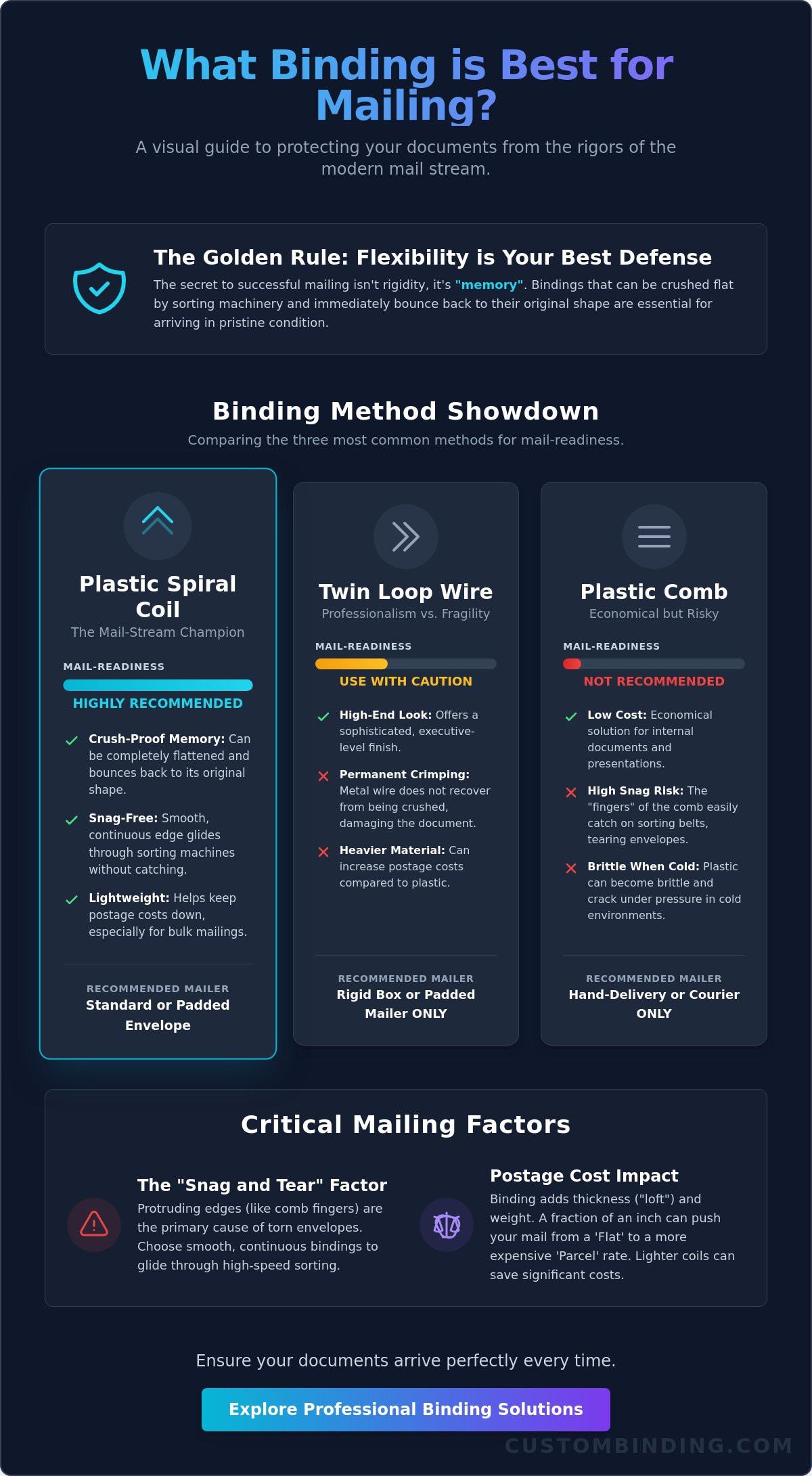
Standard office binding often fails because it's designed for static storage, not kinetic transport. Automated mail streams use high-speed belts and heavy rollers that exert significant pressure on bound edges. A key concept here is "memory." Materials like plastic spiral coils possess excellent memory; they can be crushed flat during the sorting process and immediately return to their original shape. In contrast, metal bindings often lack this resilience. In San Diego, where biotech and defense firms regularly distribute high-volume technical manuals, the reliability of the assembly is a direct reflection of the brand's professionalism.
The Impact of Binding on Postage Costs
Binding adds "loft" or thickness to your document, which can inadvertently push a piece into a higher postage tier. Under the USPS rate adjustments effective July 12, 2026, even a fraction of an inch can change a document's classification from a Flat to a Parcel. You must also consider the weight of the binding element itself. Plastic Spiral Binding Coils are significantly lighter than metal Twin Loop Binding Wire, helping you stay under weight thresholds for First-Class or Marketing Mail. This is especially relevant when calculating Dimensional Weight, where the size of the package relative to its actual weight determines the final cost.
The "Snag and Tear" Factor
The primary cause of envelope failure in the mail stream is sharp or protruding edges on binding elements. Plastic combs, while economical for internal use, have "fingers" that can easily catch on automated sorting belts, leading to torn envelopes and damaged contents. Smooth, continuous binding edges are essential for high-speed mailing. When you choose a binding style, you aren't just choosing an aesthetic; you're choosing a mechanical profile. What binding is best for mailing is ultimately the one that offers the least resistance to the machinery it must pass through, ensuring the document arrives in the recipient's hands in pristine condition.
- Plastic coils offer 360-degree rotation and crush resistance.
- Wire binding provides a high-end feel but requires protective padded mailers.
- Comb binding is best reserved for hand-delivery or courier services.
Comparing Spiral, Wire, and Comb Binding for Mail
Choosing the right assembly method is a tactical decision that impacts both the recipient's experience and your bottom line. While many professional options exist, not all meet the rigorous USPS requirements for bound materials while maintaining structural integrity. To determine what binding is best for mailing, you must evaluate how each material handles the mechanical stress of transit versus the aesthetic requirements of your brand.
Plastic Spiral Coils: The Mail-Stream Champion
High-quality Plastic Spiral Binding Coils are the industry gold standard for a reason. Their primary advantage is a unique "bounce-back" property. Unlike metal, these coils can be compressed entirely flat under the weight of other packages and immediately return to their circular shape. We recommend the 4:1 pitch standard, which places four holes per inch. This dense hole pattern provides superior structural integrity by distributing the stress of the mail stream across more connection points. For firms looking to maintain brand consistency, these coils are available in a vast array of colors to match corporate identities without sacrificing durability.
Twin Loop Wire: Professionalism vs. Fragility
Twin Loop Binding Wire offers an undeniable level of sophistication with its 3:1 or 2:1 pitch patterns. It's the preferred choice for high-stakes proposals and executive summaries. However, this professional appearance comes with a significant caveat: fragility. Once a metal wire spine is crushed or stepped on, it suffers a "permanent crimp" that cannot be easily repaired. This damage often prevents pages from turning or causes them to snag. If your project demands the look of wire, you should only ship these documents in rigid boxes or pair them with heavy-duty Regency Composition Covers to provide a mechanical buffer.
Plastic Combs and Thermal Binding
Plastic combs are a staple in many offices, but they are often unsuitable for high-volume mailing. The "fingers" of a plastic comb can become brittle over time and may pop open if the envelope is flexed during sorting. This leads to loose pages and a disorganized presentation. Thermal binding presents its own set of logistical hurdles. Thermal binding glue can soften in high-heat transit environments, leading to page loss before the document reaches the recipient. While these methods work for hand-delivered reports, they lack the mechanical security required for the national mail network.
When you consider the end-user experience, both spiral and wire allow for a true lay-flat design and 360-degree page rotation. This functionality is vital for manuals or workbooks that the recipient will use at a desk. Ultimately, what binding is best for mailing depends on your willingness to invest in protective packaging. If you want the confidence that your document will arrive in pristine condition using a standard envelope, plastic spiral is the clear professional choice.
- Plastic Spiral: Best for standard envelopes and high-speed sorting.
- Twin Loop Wire: Best for boxed shipments and premium presentations.
- Comb Binding: Best for internal use or local courier delivery.
Durability Factors: How Bindings Survive Automated Sorting
Modern postal sorting facilities are high-speed industrial environments where documents travel on conveyor belts at speeds exceeding 12 feet per second. During this journey, your mailpiece encounters heavy rollers and mechanical gates that apply significant localized pressure. To determine what binding is best for mailing, you must evaluate how a binding material responds to these physical stressors. The USPS physical standards for mailed booklets emphasize that documents must be able to withstand this automated handling without falling apart or jamming the machinery.
Flexibility is the most critical mechanical attribute for any mailed book. While many professionals assume metal is "stronger" than plastic, rigidity is actually a liability in the mail stream. Metal wire binding is strong in terms of tensile strength, but it lacks "memory." If a metal spine is crushed by a sorting roller, it deforms permanently, often pinning the pages together or creating sharp snags. Plastic, specifically high-grade PVC, is engineered to be crushed and then immediately return to its original shape. This resilience ensures the document remains functional once it reaches the recipient.
The "Crush Test" for Plastic Coils
The "Crush Test" is a simple but effective way to witness the superiority of plastic coils. A high-quality coil can be flattened to nearly 0mm under extreme pressure and will bounce back to its circular profile the moment the weight is removed. This performance depends heavily on the filament diameter; a thicker filament provides greater resistance to permanent deformation. If you are Choosing Plastic Coil Binding Supplies in San Diego for high-volume shipping, prioritizing a slightly heavier filament gauge can significantly reduce the risk of transit damage.
Friction and Heat in the Mail Stream
As documents move through sorting machines, they experience friction both from the machinery and from other mailpieces in the same bin. This friction generates heat, which can cause some lower-quality binding materials to become tacky or brittle. Using Clear Acetate Covers or Regency Composition Covers provides a vital mechanical buffer. Regency Composition Covers, in particular, offer a professional "grip" and a durable surface that protects the binding spine from direct contact with sorting belts. This extra layer of protection prevents the binding from catching or tearing through the outer envelope.
Before finalizing your production run, use this checklist to ensure your binding is mail-ready:
- Flexibility Check: Does the binding return to its original shape after being compressed?
- Edge Profile: Are the ends of the coil or wire properly crimped to prevent snagging on the envelope?
- Filament Integrity: Is the binding material thick enough to maintain its structure under the weight of several other large envelopes?
- Cover Protection: Does the cover extend slightly beyond the binding to act as a shield during transit?
By focusing on these mechanical realities, you can confidently answer what binding is best for mailing based on the specific needs of your project and the rigors of the USPS automated network.
Choosing Your Binding Based on Mailer Type
Selecting the right container is just as critical as the binding itself. To determine what binding is best for mailing, you must look at how the document interacts with its envelope. A mismatch here often leads to torn packaging or unexpected postage surcharges. For instance, the USPS classifies a "Flat" as having a maximum thickness of 0.75 inches. If your binding choice adds too much loft, your document might be reclassified as a Parcel; this significantly increases your costs.
Precision is key when measuring thickness. You should measure at the thickest point, which is typically the spine. Beyond thickness, consider the physical corners of your document. Using a professional trimmer to round the corners of your Regency Composition Covers prevents sharp edges from puncturing paper envelopes during high-speed sorting. It's a small detail that preserves the professional integrity of the entire package and ensures a smooth journey through the mail stream.
Poly Mailers vs. Paper Envelopes
Poly mailers are popular for their water resistance and light weight, but they offer very little structural support. Plastic Spiral Binding Coils are the only safe choice for these thin mailers because they flex without creating sharp pressure points. If you prefer paper envelopes, adding Clear Acetate Covers provides necessary rigidity to keep the document from folding over on itself. Always ensure a "snug fit" within the mailer. If a document shifts too much, the momentum can cause the binding to punch through the side of the envelope.
Rigid Stay-Flat Envelopes and Boxes
If your brand identity requires the premium look of Twin Loop Binding Wire, you must upgrade your packaging. Rigid stay-flat envelopes or corrugated boxes provide the mechanical shield that wire binding lacks. This is what specialists call the "Box Rule": once a document is in a box, almost any binding style is safe, though you must still monitor the total weight to manage postage. For larger campaigns, using equipment like Martin Yale Paper Folders can help you prepare additional inserts or cover letters with professional precision. This ensures they fit perfectly alongside your bound work without adding unnecessary bulk.
Review these ideal pairings to optimize your mailing strategy:
- Plastic Spiral Coils: Best for poly mailers and standard padded envelopes.
- Twin Loop Wire: Best for rigid stay-flat mailers or corrugated boxes.
- Plastic Combs: Best for oversized boxes where no compression will occur.
- Acetate Covers: Essential for adding structure to paper envelopes.
To ensure your documents travel safely and efficiently, explore our selection of professional binding supplies today.
Professional Mailing Solutions from Custom Binding Products
Establishing a streamlined production line is essential for any organization that regularly distributes bound content. At Custom Binding Products, we serve as the San Diego authority on durable document finishing, helping local industries navigate the complexities of the mail stream. When you are deciding what binding is best for mailing, having the right equipment on-site allows you to control the quality and durability of every piece before it ever leaves your facility. This control is the difference between a document that arrives in pristine condition and one that fails during transit.
Our role as a partner in your professional success extends beyond providing hardware. We understand that your reputation is often judged by the tactile quality of your presentations. Because of this, we prioritize solutions that combine mechanical reliability with a high-end aesthetic finish. Industry professionals often ask what binding is best for mailing when scaling up their operations, and the answer almost always involves a combination of resilient plastic coils and heavy-duty covers that can withstand the rigors of automated sorting.
Equipment for In-House Mailing Success
Bringing your binding processes in-house offers a significant return on investment by reducing turnaround times and eliminating external service fees. For small-to-medium mailing projects, the Akiles CoilMac-M provides a reliable, manual solution that ensures precise hole alignment for smooth coil insertion. If your operation handles high-volume commercial mailing prep, we recommend the Rhin-O-Tuff Onyx HD7700. This heavy-duty electric punch is engineered for continuous use, providing the power needed to process thick Regency Composition Covers and large document stacks without slowing down. For our local San Diego customers, we offer the added security of technical support and repair services to keep your production moving. Browse our professional binding machines to find the specific system that fits your organizational workflow.
Custom Supplies for a Tailored Professional Look
The success of a mailed document often comes down to the specific measurements of its components. Selecting the correct coil diameter for your page count is vital; a coil that's too small will pinch the pages, while one that's too large adds unnecessary loft that increases your postage costs. Clear Acetate Covers are an excellent addition for mailed reports, as they elevate the perceived value of the work while protecting the title page from transit scuffs. Custom Binding Products ensures all plastic coils are manufactured with consistent pitch to prevent machine jams during high-volume production. By maintaining a steady inventory of recurring supplies like plastic spiral coils and Regency covers, you ensure that every document reflects your commitment to quality and craftsmanship.
- Akiles CoilMac-M: Ideal for precision in mid-sized office environments.
- Rhin-O-Tuff Onyx HD7700: The commercial standard for high-volume durability.
- Regency Composition Covers: Provides a professional look with maximum transit protection.
- Consistent Pitch Coils: Prevents mechanical errors during the assembly process.
Optimize Your Distribution Strategy for Success
Choosing the right binding is a tactical investment in your brand's reputation. You now understand that flexibility and "memory" are the defining factors for survival in the automated mail stream. While plastic spiral coils offer the best resilience for standard envelopes, premium metal wire remains a viable option when paired with rigid boxes. When evaluating what binding is best for mailing, always consider the mechanical stress of the journey alongside the final aesthetic goal.
Custom Binding Products has served the San Diego community since 1988, providing the technical expertise and high-quality equipment needed for professional document finishing. We offer durable Akiles and Rhin-O-Tuff systems, backed by our expert on-site repair services to ensure your production never stops. Whether you're sending technical manuals or executive proposals, we provide the specialized supplies needed to protect your work. Shop Durable Plastic Coil Supplies for Your Next Mailing and ensure your documents arrive exactly as you intended. Your professional story deserves a flawless delivery.
Frequently Asked Questions
Is spiral binding or wire binding better for mailing?
Plastic spiral binding is significantly better for standard mailing because of its inherent flexibility. While wire binding offers a premium metallic finish, it's prone to permanent deformation if crushed by heavy packages. Spiral coils are engineered with mechanical memory, allowing them to flatten under pressure and immediately return to their original shape. This makes plastic coils the most reliable choice for documents traveling through high-speed postal sorting centers.
Will plastic coil binding get crushed in the USPS mail stream?
Plastic coil binding is designed to be crushed during the sorting process without sustaining damage. When considering what binding is best for mailing, the "crush factor" is a primary advantage of high-quality PVC coils. Unlike rigid alternatives, these coils can be compressed entirely flat by automated rollers and will bounce back instantly. This resilience prevents the binding from snagging or tearing the outer envelope during transit.
What is the cheapest binding method for bulk mailing?
Plastic Spiral Binding Coils provide the best balance of low material cost and high survival rates for bulk mailing. While plastic combs may have a lower initial price point, their tendency to crack or pop open during transit often leads to expensive document replacements. Investing in spiral coils reduces long-term costs by ensuring your professional presentations arrive intact, avoiding the hidden expenses associated with damaged mail and lost recipients.
Do I need special envelopes for bound documents?
You should select envelopes that complement the mechanical profile of your chosen binding. Padded mailers or poly envelopes work exceptionally well for spiral-bound books because they allow for slight flexing. If you're using Twin Loop Binding Wire, you must use rigid stay-flat mailers or corrugated boxes to prevent the wire from being crimped. A snug fit is essential to prevent the document from shifting and puncturing the mailer walls.
Can I mail a comb-bound book in a standard envelope?
Mailing a comb-bound book in a standard paper envelope is risky because the plastic "fingers" can easily catch on automated sorting belts. This mechanical resistance often results in torn envelopes and lost pages. If you must use comb binding for a mailed project, we recommend using a padded mailer to provide a protective buffer. This helps prevent the binding from snagging on the high-speed machinery used in modern postal facilities.
How does binding thickness affect my postage rate?
Binding thickness is a critical factor in determining whether your document is classified as a USPS Flat or a Parcel. To determine what binding is best for mailing at a lower rate, remember that Flats have a maximum thickness limit of 0.75 inches. If your binding spine exceeds this measurement, your postage costs will increase significantly. Always measure your document at its thickest point to ensure it stays within your intended budget.
What size plastic coil should I use for a 50-page report?
A 50-page report printed on standard 20lb paper typically requires a 9mm or 10mm plastic coil. This specific diameter provides enough internal clearance for the pages to turn freely without adding excessive loft to the document. Choosing the smallest functional diameter helps keep your mailpiece thin, which is essential for staying within the more affordable USPS Flat postage category and reducing overall shipping expenses.
Where can I get binding machine repair in San Diego if my mailer production stops?
Custom Binding Products provides expert on-site repair services for local San Diego customers to minimize production downtime. Our specialists are trained to service professional equipment like the Rhin-O-Tuff Onyx HD7700 and Akiles systems. If your high-volume mailing project is stalled by a mechanical issue, our team can provide the technical support needed to get your production line back on track quickly and efficiently.