
Reducing Document Finishing Costs: A Strategic Guide for San Diego Businesses
Jun 13th 2026

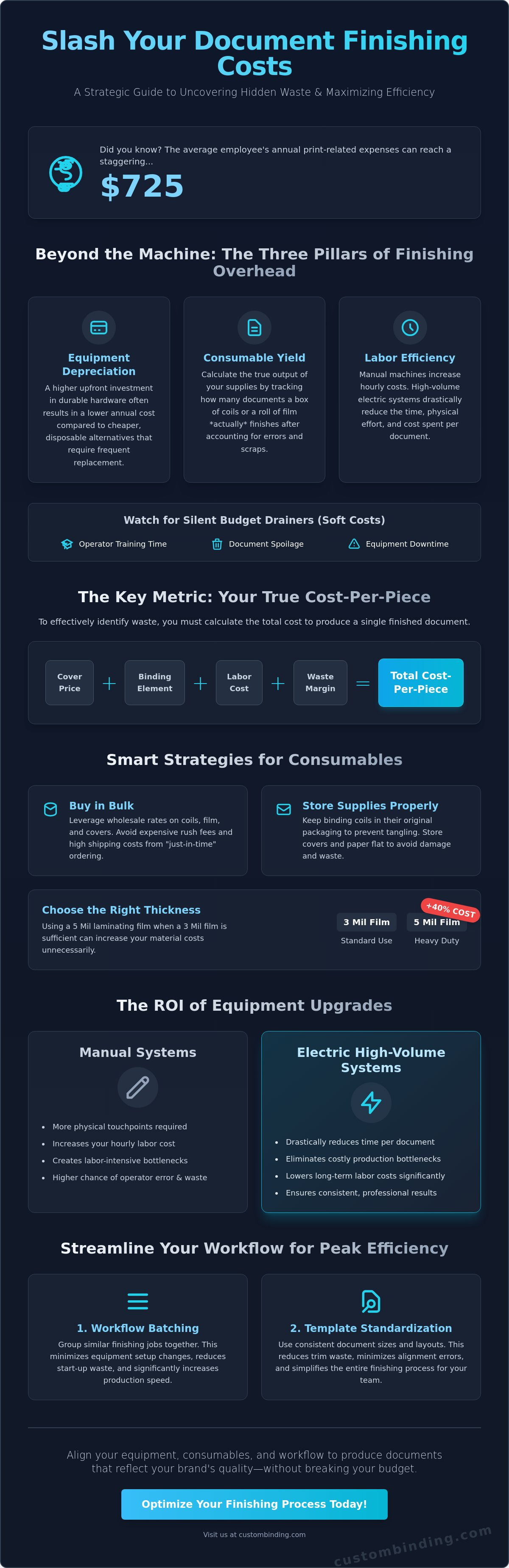
Did you know the average employee’s print-related expenses can reach $725 annually? For San Diego businesses already managing local costs like the minimum wage enforcement fee, every operational dollar must work harder. It’s a common challenge to balance a professional aesthetic with the reality of unpredictable supply prices and the high labor costs of manual assembly. You deserve a finishing process that is as efficient as it is elegant. This guide provides a strategic approach to reducing document finishing costs by helping you audit your current workflow for hidden waste.
We’ll show you how to implement high-ROI efficiency strategies and select reliable equipment that minimizes expensive downtime. You’ll learn how to lower your cost-per-piece and ensure your physical documents always reflect the high quality of your professional brand. This framework allows you to move from disorganized preparation to a streamlined, well-oiled production process that respects both your time and your budget.
Key Takeaways
- Identify hidden "soft costs" such as operator training and document spoilage to uncover the true impact on your operational budget.
- Discover the financial benefits of purchasing laminating film and binding coils at wholesale rates while selecting the ideal material thickness for every project.
- Determine the ROI of upgrading from manual punches to high-volume electric systems to eliminate repair fees and reduce labor-intensive bottlenecks.
- Implement workflow batching and template standardization as essential methods for reducing document finishing costs and minimizing material waste.
- Leverage expert audits to align your equipment with high-quality consumables, ensuring every report reflects the professional reputation of your business.
What Are Document Finishing Costs? Identifying Hidden Expenses
Managing a business in San Diego requires a sharp eye for operational efficiency. While many professionals focus on the initial purchase price of a binding machine or laminator, the true cost of finishing a document is far more complex. It's the cumulative total of your machinery, consumables, and the human labor required to operate them. Understanding these variables is the only way to begin reducing document finishing costs without compromising the tactile quality of your presentations.
There is a significant difference between one-time equipment fees and recurring supply expenses. A high-quality punch or folder is a capital investment that provides value over many years. In contrast, recurring costs for items like Plastic Spiral Binding Coils or Roll Laminating Film can fluctuate based on volume and waste. Beyond these visible figures, "soft costs" often drain budgets silently. Document spoilage from mispunches, operator training time for complex systems, and the ripple effect of equipment downtime all contribute to a higher overhead than most executives realize.
The Three Pillars of Finishing Overhead
To master your budget, you must analyze three specific areas of your production line:
- Equipment Depreciation: This involves spreading the cost of a durable machine, such as an Akiles CoilMac-M, over its functional lifespan. A reliable specialist knows that a higher upfront investment in durable hardware often leads to a lower annual cost than cheaper, disposable alternatives.
- Consumable Yield: You must calculate the actual output of your supplies. This means tracking how many reports a single box of Twin Loop Binding Wire actually finishes after accounting for errors and scraps.
- Labor Efficiency: This is the most volatile pillar. Manual machines require more physical touchpoints, which increases your hourly cost. Transitioning to an electric high-volume system like the Rhin-O-Tuff Onyx HD7700 can drastically reduce the time spent per document.
Why Tracking 'Cost-Per-Piece' Matters
The most effective way to identify waste is to calculate your cost-per-piece. To do this, add the individual price of a Regency Composition Cover and a binding element to the labor cost required for assembly. Don't forget to include a small margin for material waste. If your team frequently restarts projects because of alignment issues, your cost-per-piece is likely higher than it should be.
Precision tools play a vital role here. Using a Dahle Professional Rolling Trimmer ensures that every edge is clean on the first pass, which prevents the waste of expensive Clear Acetate Covers. When you identify which project types are draining your resources, you can make informed decisions about whether to standardize your templates or upgrade to more automated equipment like a Martin Yale Paper Folder. This methodical approach ensures that every dollar spent contributes to a superior professional outcome.
Optimizing Consumables: Saving on Coils, Film, and Covers
While the initial cost of a machine is a visible line item, the long-term expense of consumables often dictates your department's true efficiency. High-quality supplies are an investment in your professional image, but poor management of these materials leads to significant financial leakage. A strategic approach to reducing document finishing costs focuses on high-yield material selection and the elimination of physical waste during the production cycle.
Minimizing "lead-in" waste on your roll laminator during startup is a simple yet effective tactic for reducing material waste and preserving your budget. Every inch of Roll Laminating Film that passes through the rollers before the first document is fed represents lost profit. Similarly, standardizing your cover sizes to match stock dimensions reduces the need for custom trimming. This precision saves time and ensures that you aren't paying for material that eventually ends up in the recycling bin. Choosing a 5 Mil film when a 3 Mil thickness suffices often increases material costs by up to 40% without providing a proportional benefit to the project's utility.
Bulk Purchasing and Inventory Management
San Diego businesses can gain a competitive edge by leveraging local wholesale supply options. Relying on "just-in-time" ordering often backfires when unexpected rush fees and high shipping costs erode your margins. It's far more efficient to maintain a steady stock of essential elements. Correct storage is equally vital. Ensure you store Plastic Spiral Binding Coils in their original packaging to prevent tangling and damage. This organized approach prevents the frustration of discarded, unusable supplies and keeps your production line moving with a steady, logical rhythm.
Material Selection for Professional Durability
Selecting the right material for the specific application is a hallmark of a seasoned specialist. For internal reports or high-volume distributions, Regency Composition Covers provide a durable, professional look at a lower price point than premium alternatives. Reserve Clear Acetate Covers for client-facing presentations where a high-gloss, tactile first impression is critical. Precision also extends to your binding elements. Always match your Twin Loop Binding Wire pitch exactly to your document size. Using the wrong size leads to poor mechanical movement and document failure, which necessitates expensive re-runs. Securing your supplies through wholesale binding and laminating channels ensures you maintain a professional inventory without the premium price tag.
The ROI of Equipment Upgrades: Repair vs. Replace
Deciding whether to repair an aging machine or invest in a new system is a pivotal moment for any production manager. While a quick fix might seem economical in the short term, frequent repairs for legacy binding machines often become a "sunk cost" that drains your annual budget. A critical component of reducing document finishing costs involves evaluating the true return on investment (ROI) of your hardware. When a machine requires more than two professional service calls in a single year, the labor loss and repair fees often exceed the monthly lease or purchase cost of a modern replacement.
Precision equipment is your first line of defense against the "re-do" costs mentioned in previous sections. Older manual punches often suffer from die-wear, leading to misaligned holes that ruin entire stacks of Regency Composition Covers. High-volume electric systems like the Rhin-O-Tuff Onyx HD7700 eliminate this human error with consistent, vertical punching power. Modern systems also prioritize energy efficiency. A Tamerica Optimus-450 laminator, for example, utilizes advanced heating elements that reach operational temperatures faster and use less power during idle periods than older industrial models. These incremental savings in electricity and material accuracy significantly lower your cost-per-piece over the life of the machine.
When to Invest in Heavy-Duty Machinery
Calculating the "break-even" point for an upgrade requires a simple look at your monthly volume. If your team spends more than five hours a week manually inserting coils, the labor savings from an electric coil inserter will typically pay for the machine within the first year. For offices managing high-volume reports, the GBC CombBind C800pro provides a streamlined workflow that allows a single operator to finish twice as many documents as a manual system. Even smaller tools contribute to long-term savings; professional Dahle Professional Rolling Trimmers feature self-sharpening blades that reduce the need for frequent blade replacements, ensuring a clean tactile edge on every acetate cover without recurring maintenance fees.
The True Cost of Equipment Maintenance
Identifying signs that your equipment needs professional San Diego service is essential for preventing catastrophic failures during a deadline. Listen for grinding gears, inconsistent punch depths, or "silvering" in your laminating film, which indicates a failing heating element. Preventative maintenance is the practice of scheduled mechanical inspections, typically performed every six to twelve months, to identify wear on internal components before they cause a total system failure. By staying ahead of mechanical fatigue, you ensure your production line remains a well-oiled process that supports your professional reputation rather than hindering it.
5 Strategic Ways to Streamline Your Finishing Workflow
A well-organized workflow is the final piece of the puzzle in reducing document finishing costs. While high-quality equipment and wholesale supplies provide the foundation, the way your team interacts with these tools determines your daily profitability. Friction in the production line often stems from fragmented tasks and inconsistent operator knowledge. By treating your finishing area as a precision production environment, you can implement a logical rhythm that prioritizes reducing document finishing costs through organized efficiency.
Standardizing your document templates to match stock binding element sizes is a critical first step. When your reports consistently fit standard Plastic Spiral Binding Coils, you eliminate the need for custom orders or manual trimming. Implementing a centralized finishing station further streamlines the process. Consider these five strategies to optimize your workspace:
- Batching: Grouping similar jobs to reduce machine warm-up cycles and film waste.
- Standardization: Designing templates that align with stock Regency Composition Covers.
- Centralization: Placing all equipment in one dedicated, logical production area.
- Setting Mastery: Training staff on precision settings for specific document volumes.
- Cross-training: Teaching employees basic troubleshooting to minimize mechanical downtime.
This organized approach ensures that all operators have immediate access to necessary supplies like Twin Loop Binding Wire. It also prevents minor mechanical issues from stalling your entire production schedule.
Workflow Automation and Batching
Running fifty laminating jobs in a single session is significantly more cost-effective than performing fifty separate runs throughout the day. Batching reduces total machine warm-up times and minimizes the Roll Laminating Film waste associated with repeated startups. To further automate your output, integrate Martin Yale Paper Folders into your line. These machines eliminate the slow, manual labor of hand-folding, ensuring that your reports are ready for binding in a fraction of the time. This methodical flow prevents operators from feeling overwhelmed by technical choices and ensures a superior professional outcome.
Staff Training and Quality Control
Human error is often the largest source of material spoilage. Establish a "test sheet" protocol where operators punch a scrap page before starting on the final document. This simple check ensures that the side margin and depth of punch are perfectly aligned. Create accessible "cheat sheets" for common binding machine settings to guide even novice users through the process. On roll laminators, training staff to set correct heat levels prevents bubbling and ensures the tactile experience of the final product reflects your brand’s quality. For a deeper audit of your current processes, you can consult with a document finishing specialist to identify specific bottlenecks in your San Diego office.
Partnering with Custom Binding Products for Long-Term Savings
Efficiency is rarely the result of a single purchase; it's the outcome of a sustained strategy. While the previous sections of this guide provide a framework for internal audits, a dedicated partner simplifies the process of reducing document finishing costs. Leveraging over 30 years of specialized San Diego expertise allows you to bypass common pitfalls and move directly to high-ROI solutions. We don't just supply hardware; we provide the technical precision required to ensure your production line remains organized and reliable.
Accessing wholesale pricing on essential materials like Plastic Spiral Binding Coils, Twin Loop Binding Wire, and Roll Laminating Film is a primary driver of cost reduction. By securing these high-value consumables through a specialist, you maintain the professional aesthetic of your reports without the retail markup. We provide customized equipment recommendations based on your unique volume and budget. This ensures you never over-specify your machinery or pay for features your workflow doesn't require.
The Local Advantage for San Diego Businesses
Operating within San Diego County offers distinct logistical benefits that national suppliers cannot match. You can eliminate the friction of high shipping costs and unpredictable delivery windows by utilizing local supply pickup and delivery options. When equipment issues arise, our fast response times for on-site repair ensure your project stays on schedule. We also offer hands-on demonstrations of industry-leading hardware, such as Akiles and Rhin-O-Tuff systems. This allows your team to experience the mechanical movement and tactile quality of the equipment before making a capital investment, ensuring the tool fits the task perfectly.
Tailored Solutions for Professional Identity
Your physical documents serve as a recurring marker of your commitment to quality. Custom Binding Products helps you select supplies that reflect your brand's reputation, from the density of your laminating film to the physical feel of Regency Composition Covers. A long-term partnership provides the stability needed to navigate changing document finishing trends while maintaining a consistent cost-per-piece. This methodical approach removes the guesswork from preparation tasks. It allows you to focus on the content of your work while we handle the precision of the assembly.
Schedule a professional finishing audit with Custom Binding Products today to identify hidden waste and streamline your production workflow.
Secure Your Professional Image and Your Budget
Achieving a polished, professional presentation doesn't have to come at the expense of your bottom line. By auditing hidden soft costs, optimizing your consumable yield, and embracing high-ROI equipment upgrades, you can transform a chaotic preparation process into a well-oiled production line. These strategies provide a clear path for reducing document finishing costs while ensuring every report you produce reflects the high standards of your San Diego business.
Since 1988, we've served the local professional community as a reliable specialist in document presentation. As an authorized dealer for industry leaders like Akiles, Rhin-O-Tuff, and GBC, we provide the specialized hardware and expert on-site repair services needed to keep your operations running without friction. Don't let inefficient workflows or aging machinery drain your resources. Every physical document is an investment in your reputation; make sure that investment is managed with precision.
Optimize your finishing costs with a Custom Binding Products expert today and take the first step toward a more organized, cost-effective future. You've done the hard work of creating the content; let us help you finish it with the craftsmanship it deserves.
Frequently Asked Questions
How can I tell if my laminating film is being wasted?
Excessive "lead-in" and "tail-out" film on your roll laminator is the clearest sign of material waste. If you're running single sheets instead of batching multiple documents, you're losing several inches of Roll Laminating Film with every startup. Visible bubbling or silvering also indicates that your heat settings are incorrect. This leads to document spoilage and requires expensive re-runs that drain your budget.
Is it cheaper to use a manual or electric binding machine?
Electric machines are more cost-effective for medium to high-volume workflows because they drastically reduce labor hours. While a manual punch like the Akiles CoilMac-M has a lower initial price, an electric system like the Rhin-O-Tuff Onyx HD7700 processes documents much faster. Over time, the reduction in hourly labor costs far outweighs the equipment investment, making electric systems a vital tool for reducing document finishing costs.
What is the most cost-effective binding style for large documents?
Plastic Spiral Binding Coils are generally the most economical choice for high-page-count reports and manuals. These coils are durable, allow for 360-degree page rotation, and cost less than Twin Loop Binding Wire for thicker documents. Standardizing your large projects to a specific coil diameter allows you to purchase supplies in bulk, which further lowers your cost-per-piece for professional presentations.
Can I save money by repairing my 10-year-old binding machine?
Repairing a decade-old machine is only economical if the issue involves a simple, replaceable wear part. If the internal gears or punching dies are failing, the cumulative cost of service calls and downtime will soon exceed the price of a new unit. Newer machines provide better precision and energy efficiency. This helps in reducing document finishing costs by preventing the material waste caused by misaligned punches.
Does bulk buying binding supplies really save money after shipping?
Bulk buying provides significant savings, especially when you partner with a local San Diego supplier to eliminate high freight charges. Purchasing Plastic Spiral Binding Coils or Regency Composition Covers in large quantities reduces the unit price. By utilizing local pickup or delivery options, you bypass the expensive shipping fees typically associated with heavy boxes of wire or film, keeping your supply budget predictable.
How do I reduce labor costs in my document finishing department?
Automating repetitive manual tasks is the most effective way to lower your labor overhead. Integrating a Martin Yale Paper Folder or an electric coil inserter removes slow, hand-assembly steps from your production line. Cross-training your staff to handle basic troubleshooting also prevents expensive work stoppages. This ensures your department operates with a steady, logical rhythm that maximizes output without increasing your headcount.
What is the difference between pouch and roll lamination for cost savings?
Roll lamination is significantly cheaper for high-volume projects and large-format documents. While Laminating Pouches are convenient for occasional, small items, Roll Laminating Film offers a much lower cost-per-square-inch. For a busy office environment, the speed and material efficiency of a roll system like the Tamerica Optimus-450 provide superior long-term value compared to the higher per-unit cost of individual pouches.
How often should I service my professional finishing equipment?
Schedule professional preventative maintenance every six to twelve months, depending on your actual production volume. Regular inspections identify minor wear on components like punch pins or heating rollers before they cause a total system failure. Consistent servicing ensures your equipment remains reliable and prevents the expensive, last-minute repair fees that often occur when machines are pushed to their limits during critical deadlines.