
High-Volume Document Binding Solutions: A 2026 Guide to Industrial Efficiency
Jun 5th 2026
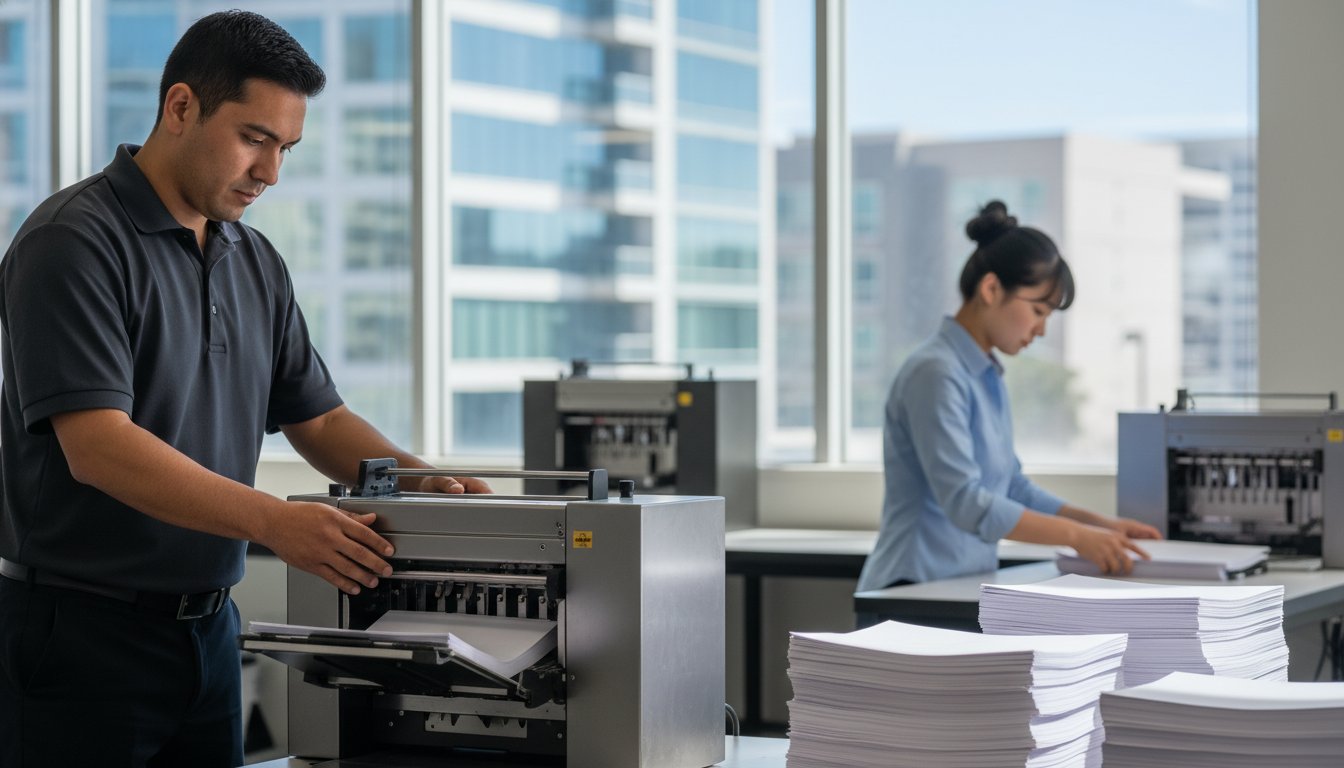
The most expensive component of your document production isn't the paper or the ink; it's the time lost to a bottlenecked finishing line. When your team struggles with manual punching fatigue or inconsistent hole alignment at scale, your entire operation suffers. High-volume output requires more than just raw speed. It demands commercial grade binding machines that pair mechanical durability with ergonomic precision to eliminate backlogs during your busiest seasons.
We understand that equipment downtime isn't just an inconvenience; it's a direct threat to your professional reputation. You deserve a workflow that delivers a standardized, professional finish every time, supported by the reliability of local San Diego experts. This guide provides the strategic roadmap you've been looking for to reduce labor hours per document and maximize industrial efficiency. We'll explore high-capacity systems from industry leaders like Akiles and Rhin-O-Tuff, while detailing the workflow strategies that turn high-volume preparation into a seamless, tactile success story for your organization.
Key Takeaways
- Identify the critical transition point when your output exceeds 100 documents per week, requiring a shift from standard office tools to industrial-grade hardware.
- Scale your production capacity by integrating commercial grade binding machines like the Rhin-O-Tuff Onyx HD7700, which offers heavy-duty punching and customizable die pins for clean margins.
- Eliminate common bottlenecks by pairing high-capacity punches with electric coil inserters and automated wire closers to accelerate the final assembly phase.
- Optimize your workspace using a linear production model that incorporates precision paper handling tools like Dahle Professional Rolling Trimmers for a standardized finish.
- Minimize equipment downtime through proactive preventative maintenance and leverage local San Diego on-site support to keep your high-volume operations running smoothly.
Defining High-Volume Document Binding Solutions for 2026
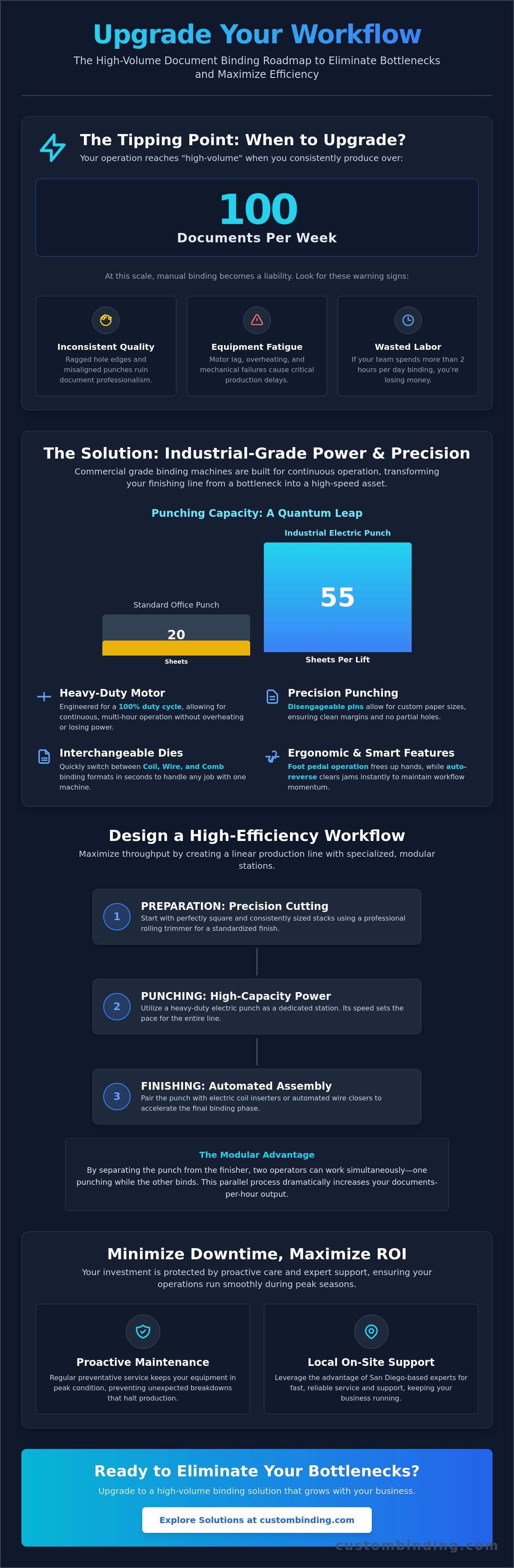
High-volume isn't a vague term. For 2026, it refers to any operation consistently producing over 100 documents every week. At this scale, manual punching isn't just slow; it's a liability. You need commercial grade binding machines that can withstand the rigors of daily, multi-hour operation without losing precision. When your output reaches this threshold, the efficiency of your equipment directly dictates your profit margins and your team's productivity.
The process of building a book or a high-stakes corporate report involves more than just stacking paper. It's about structural integrity and tactile quality. This is where the concept of a "Duty Cycle" becomes vital. A machine's duty cycle determines how long it can operate under load before requiring a cooling period. Industrial-grade hardware is built for a 100% duty cycle, meaning it won't quit during a 48-hour production sprint. For high-stakes presentations, a professional finish is non-negotiable. The assembly quality reflects the quality of the work contained within, acting as a critical component of your professional identity.
The Threshold: When to Upgrade Your Equipment
Labor costs in San Diego continue to rise, making manual tasks like hand-punching 20 sheets at a time a poor use of resources. If your team spends more than two hours a day at the binding station, you've reached the upgrade threshold. Standard office binders aren't designed for this level of mechanical stress. Look for these specific signs of equipment fatigue:
- Ragged or uneven hole edges on thicker document stacks
- Motor lag or overheating during continuous punching cycles
- Inconsistent hole alignment that ruins the document's professional margin
These mechanical failures lead to production delays that can jeopardize client delivery timelines. Investing in industrial equipment isn't just about speed; it's about eliminating the friction that slows down your entire finishing line.
Key Components of an Industrial Binding System
Speed starts with the motor. Systems like the Rhin-O-Tuff Onyx HD7700 use heavy-duty electric punching motors that can handle up to 55 sheets per lift, significantly outperforming manual lever systems. This mechanical power ensures that even the densest acetate covers are punched with clean, crisp edges. Versatility is another hallmark of industrial equipment. High-volume environments benefit from interchangeable die systems that allow you to switch between coil, wire, and comb formats in seconds.
You should also consider the configuration of your workspace. While all-in-one machines are convenient, modular configurations are superior for high-speed environments. By separating the punch from the finisher, two operators can work simultaneously. This creates a linear, high-efficiency workflow that maximizes your investment in commercial grade binding machines. This structural logic ensures that even as your volume grows, your production pace remains steady and reassuring.
The Mechanics of Speed: Heavy-Duty Electric Punching
High-volume document production begins and ends with the punch. If your punching engine stalls, your entire finishing line stops. Investing in commercial grade binding machines like the Rhin-O-Tuff Onyx HD7700 addresses the physical demands of mass production by providing a heavy-duty electric motor designed for continuous duty cycles. This machine has established itself as the industry benchmark because it moves beyond the limitations of desktop equipment, offering the raw power needed to process thousands of pages daily.
Precision is just as important as power in a professional setting. The HD7700 features disengageable pins, allowing an operator to pull specific punch pins to accommodate custom document sizes without leaving unsightly half-holes at the edges. This ensures clean margins for every project, whether you're working with standard letter size or oversized legal covers. To maintain momentum during long runs, the system includes an auto-reverse feature. If an operator accidentally overloads the punch, the machine automatically reverses the pins to clear the jam, preventing the mechanical strain that often leads to equipment downtime.
Operators also benefit from foot-pedal operation. By moving the trigger to the floor, you free up both hands to align paper and manage stacks. This simple ergonomic shift significantly increases hourly throughput. When your workflow follows the Government Printing and Binding Regulations for professional-grade output, these mechanical efficiencies become essential for maintaining consistency across large batches.
Electric vs. Manual: Calculating the ROI of Speed
The transition to industrial commercial grade binding machines is often justified by the sheer volume of paper handled per lift. While a high-end manual punch might manage 15 to 20 sheets, the HD7700 handles up to 55 sheets per lift. For a typical San Diego office processing a batch of 500-page documents, this reduces the number of punch cycles by over 60%. Beyond time savings, this shift drastically reduces the risk of repetitive strain injuries (RSI) for your production staff, as the motor does the heavy lifting that a human shoulder would otherwise perform.
Modular Punching with the Rhin-O-Tuff Onyx Series
One of the greatest advantages of the Onyx series is its modularity. You don't need three separate machines for coil, wire, and comb binding. Instead, you use one heavy-duty chassis with interchangeable dies. These all-metal dies are built for the friction of high-use print environments and can be swapped in under 60 seconds. This versatility allows you to pivot between different client requests without cluttering your workspace with redundant hardware. If you're ready to upgrade your production floor, exploring the Rhin-O-Tuff Onyx series is a logical first step toward achieving true industrial efficiency.
Beyond the Punch: Automated Finishing and Thermal Alternatives
While the heavy-duty punching discussed in the previous section provides the raw power to process stacks of paper, the true test of industrial efficiency lies in the finishing stage. In many operations, "insertion" becomes the primary bottleneck. This is the manual act of threading a coil or wire through the punched holes. If your team is still hand-twisting plastic coils into documents, you aren't maximizing the potential of your commercial grade binding machines. To transform a high-volume production line, you must integrate specialized finishing tools like electric coil inserters and automated wire closers.
Brands like Akiles and Tamerica offer modular finishing solutions that decouple the punching and binding phases. This is a critical strategic move. By using a standalone inserter, you allow one operator to punch while another binds, doubling your throughput immediately. Adhering to Federal Printing and Binding Standards requires this level of precision and consistency, ensuring that every document meets rigorous quality assurance benchmarks. This modularity prevents the "all-in-one" logjam where a single machine dictates the speed of the entire staff.
Electric Coil Insertion vs. Manual Twisting
Electric rollers are the engine of rapid finishing. Instead of hand-twisting, an operator holds the punched document against a spinning rubber roller that "walks" the coil through the holes in seconds. This is especially vital for thick documents where manual friction makes hand-insertion nearly impossible over long runs. For a complete industrial setup, electric crimping pliers are a necessity. They provide a uniform cut and crimp on every document, ensuring both safety and speed. Some industry case studies show that moving from manual methods to dedicated modular inserters can reduce finishing time by as much as 70%, allowing your staff to focus on quality control rather than repetitive mechanical tasks.
Thermal Binding: The Speed King for Specific Use Cases
There are times when mechanical binding styles like coil or wire aren't the most efficient choice. Thermal binding stands as the speed king for specific high-volume use cases, such as annual reports or legal briefs. This method uses heat to fuse pages into a pre-glued spine, resulting in a professional, book-like aesthetic often referred to as perfect binding. It's a solution that balances speed with a high-end tactile experience.
The primary advantage here is the "no-punch" workflow. Because you don't have to punch holes in the paper, you eliminate the most time-consuming step of the entire process. This makes thermal binding ideal for ultra-thick document stacks that would otherwise require dozens of punch lifts. While it lacks the 360-degree fold-back capability of spiral coils, the finished product offers a sense of permanence and authority that's unmatched in corporate settings. Choosing between these systems depends on whether your priority is the functional durability of a spiral or the sleek, executive finish of a thermal spine. Both paths require commercial grade binding machines to maintain the necessary production pace.
Designing a High-Efficiency Binding Workflow
The speed of your commercial grade binding machines only matters if the rest of your production line can keep up. Industrial efficiency is the result of a well-organized workspace where every movement is intentional. To achieve this, you must establish a linear production flow that moves logically from printing to trimming, and finally to binding. By positioning your equipment in a straight line or a tight "U" shape, you minimize the physical distance operators must travel with heavy stacks of paper, reducing both time and physical fatigue.
Precision paper handling equipment is the foundation of this workflow. Before a document ever reaches the punch, it should be perfectly squared using tools like Dahle Professional Rolling Trimmers. These trimmers ensure that every edge is crisp and uniform, which is essential for maintaining consistent hole alignment during the punching phase. For projects involving multi-page inserts or brochures, Martin Yale paper folders automate the preparation process. This prevents the bottleneck of manual folding and ensures that your documents are ready for the binding station as soon as they leave the printer.
Organization of supplies is equally critical. Store your Plastic Spiral Binding Coils, Twin Loop Binding Wire, and covers in clearly labeled, accessible bins at eye level. This prevents the "search and find" delays that often occur during peak production periods. When your operators can reach for a Regency Composition Cover without breaking their rhythm, your hourly output remains steady and predictable. To optimize your own production floor, you can browse our full range of paper handling and binding supplies to build a truly integrated system.
Ergonomics and Operator Comfort
Productivity is a direct byproduct of operator comfort. Set your punching and inserting stations at optimal table heights to prevent hunching and back strain. High-volume commercial grade binding machines generate a significant amount of paper "chips" or waste. Ensure your stations are equipped with high-capacity waste bins and that chip collection systems are emptied at scheduled intervals. Implementing batch processing techniques-where an operator punches an entire run before moving to the insertion phase-often maximizes throughput by allowing the staff to settle into a consistent mechanical rhythm.
Quality Control at Scale
Maintaining a professional finish across a run of 500 documents requires strict quality control standards. Always standardize your margin depths and hole alignment at the start of a shift using a test sheet. The tactile experience of the final product is what defines your brand's reputation. By selecting high-quality clear acetate and Regency composition covers, you provide a consistent, premium feel that reflects the quality of the data inside. For an even more polished look, consider using a corner rounder to provide a snag-free, executive finish that distinguishes your work from generic, mass-market presentations.
The San Diego Advantage: Local Support for Commercial Operations
Investing in commercial grade binding machines is a commitment to long-term industrial efficiency. However, even the most durable hardware requires a strategic support system to maintain peak performance. High-volume environments put thousands of cycles on equipment every month, making regular preventative maintenance essential to avoid the catastrophic downtime that can stall a production line. While national web-box retailers focus solely on the initial sale, they often leave local businesses stranded when a 100-pound industrial punch requires service or calibration.
Purchasing from a local partner like Custom Binding Products provides a level of security that national shipping-based companies cannot match. Shipping heavy machinery back for repair is not only expensive but can take weeks to resolve, leading to missed deadlines and lost revenue. By choosing a San Diego-based expert, you gain access to on-site technical support and a partner who understands the specific demands of your local operation. This proximity allows for immediate pickup of bulk supplies like Plastic Spiral Binding Coils and Twin Loop Binding Wire, ensuring your workflow never stops due to a shipping delay.
Preventing Downtime with Local Maintenance
Heavy-duty electric punches and inserters have specific mechanical wear points that require professional attention. Over time, punch pins can dull and inserter rollers can lose the friction necessary for rapid coil movement. Our technical support team specializes in the maintenance of these industrial systems, offering an on-site repair process that minimizes disruption to your facility. For San Diego businesses operating under tight project deadlines, our emergency repair capabilities act as a critical safety net, providing the steady hand needed to keep your finishing line moving during peak production periods.
Customized Supply Solutions for Large Organizations
Managing a high-volume facility involves more than just equipment; it requires a reliable pipeline of consumables. We offer wholesale procurement for items like Roll Laminating Film and Regency Composition Covers, allowing you to maintain a premium professional aesthetic while benefiting from bulk pricing. Our team can implement tailored inventory management systems for your recurring supply needs, preventing the stockouts that often occur during unexpected high-volume runs. By linking your physical supplies to a local inventory, you ensure that your commercial grade binding machines always have the materials they need to produce executive-level results. Schedule a binding workflow consultation for your San Diego facility to optimize your production floor today.
Future-Proof Your Document Finishing Strategy
Achieving industrial efficiency requires a shift from viewing binding as a manual chore to treating it as a precision mechanical process. By identifying your production thresholds and integrating commercial grade binding machines, you eliminate the labor bottlenecks that stall growth. Whether you prioritize the raw power of a Rhin-O-Tuff punch or the automated finishing speed of an Akiles inserter, your equipment should act as a reliable partner in your professional success.
Custom Binding Products has served San Diego businesses since 1988, providing the specialized expertise needed to maintain complex production lines. As an authorized dealer for industry leaders like Rhin-O-Tuff and Akiles, we don't just sell hardware; we provide dedicated on-site technical repair and maintenance services to ensure your operations never falter. Our commitment to your reputation is reflected in every component we support, from heavy-duty motors to precision-engineered dies.
Upgrade your production with high-volume binding solutions from Custom Binding Products and experience the tactile difference of professional craftsmanship. Your team's productivity and your brand's reputation deserve the steady hand of organized, high-speed efficiency.
Frequently Asked Questions
What is the fastest binding method for high-volume projects?
Thermal binding is the fastest method for high-volume projects because it eliminates the manual punching step entirely. By using pre-glued covers and a heat-based system, you can bind multiple documents at once in just a few minutes. If you require a mechanical finish like coil or wire, pairing a heavy-duty electric punch with a standalone electric inserter is the next most efficient way to maintain a rapid production pace.
Can one machine handle multiple binding styles for a large office?
Yes, modular punching systems are designed to handle multiple binding styles through the use of interchangeable die sets. High-volume commercial grade binding machines like the Rhin-O-Tuff Onyx series allow you to switch between coil, wire, and comb dies in less than a minute. This flexibility allows a large office to produce a variety of professional document formats using a single, heavy-duty power base, saving both space and equipment costs.
How many sheets can a heavy-duty electric punch handle at once?
Industrial electric punches typically handle up to 55 sheets of 20 lb paper in a single lift. This high capacity allows your team to process thick documents with significantly fewer punch cycles than standard office equipment. Machines like the HD7700 are built with heavy-duty motors designed for 100% duty cycles, meaning they can maintain this punching volume throughout a full workday without the risk of overheating or mechanical lag.
Is thermal binding durable enough for frequently used manuals?
Thermal binding offers excellent durability for executive reports and presentations, but plastic coil is often better for frequently handled manuals. While the adhesive used in thermal systems is incredibly strong, it doesn't allow a document to lay completely flat or fold back 360 degrees. For manuals that will be used daily in a workshop or classroom, the flexibility and resilience of plastic spiral coils provide a more functional and long-lasting solution.
Do you offer on-site repair services for binding machines in San Diego?
We provide dedicated on-site repair and preventative maintenance services for commercial grade binding machines throughout the San Diego region. Our technicians are experts in industrial hardware, ensuring that your equipment remains in peak condition to avoid costly production delays. Because we're local, we can provide rapid response times and emergency service that national retailers simply cannot offer, keeping your finishing line operational when deadlines are tight.
What is the difference between modular and all-in-one binding machines?
The main difference is how they impact your workflow and operator productivity. All-in-one machines house the punch and the finisher in a single unit, which is compact but restricts the work to one person. Modular systems separate the punching and finishing components, allowing two operators to work simultaneously. This separation is vital for high-volume environments where you need to maximize the number of finished documents produced every hour.
How do I choose between coil and wire binding for high-volume reports?
Your choice should depend on the document's end use and the desired aesthetic. Plastic spiral coils are the best choice for durability and functionality, as they can withstand heavy handling and allow the book to fold back on itself. Twin loop binding wire is the preferred option for high-stakes corporate reports where a sophisticated, metallic finish is required. While wire looks more professional, it's less resilient to being crushed during shipping or storage.
Are there automatic machines for inserting coils into documents?
There are specialized electric coil inserters designed to automate the most time-consuming part of the spiral binding process. These machines use spinning rollers to rapidly thread the coil through the punched holes, finishing a document in a fraction of the time it takes to do so manually. Integrating an electric inserter into your production line is a critical step for any organization looking to transform its document preparation into a streamlined, industrial-scale operation.