
ROI Calculator for Buying a Binding Machine: Is In-House Finishing Worth It?
May 15th 2026

What if that $10 invoice for a single bound report is actually costing your business five times that amount once you factor in the "Wait-Time Tax" and the loss of creative control? Many professionals in San Diego find themselves at the mercy of external print centers, facing inconsistent quality and high per-document fees. Using an ROI calculator for buying a binding machine is the first step toward reclaiming your timeline and ensuring your presentations reflect the true quality of your work.
You've likely suspected that your current outsourcing model is inefficient, and you're right to look for a more sustainable path. We'll help you discover the exact math behind document finishing to determine if buying a binding machine will save your business money over outsourcing. This guide examines the performance of professional systems like the Akiles CoilMac-M and Rhin-O-Tuff Onyx HD7700. You'll gain a clear framework to compare coil versus wire styles and identify the document volume required to see a full return on your investment within 12 to 18 months.
Key Takeaways
- Identify your break-even point by calculating when cumulative in-house savings will fully offset the purchase price of professional finishing equipment.
- Use a precise ROI calculator for buying a binding machine to account for hidden outsourcing costs like retail markups and lost employee productivity.
- Compare the long-term value of various binding styles, from the versatility of plastic spiral coils to the executive finish of twin loop wire.
- Determine the ideal machine for your specific volume, ensuring your payback period remains within a target window of 12 to 18 months.
- Learn how sourcing supplies locally in San Diego can further boost your ROI by eliminating heavy-package shipping fees and reducing equipment downtime.
Calculating the ROI of Your Binding Machine Investment
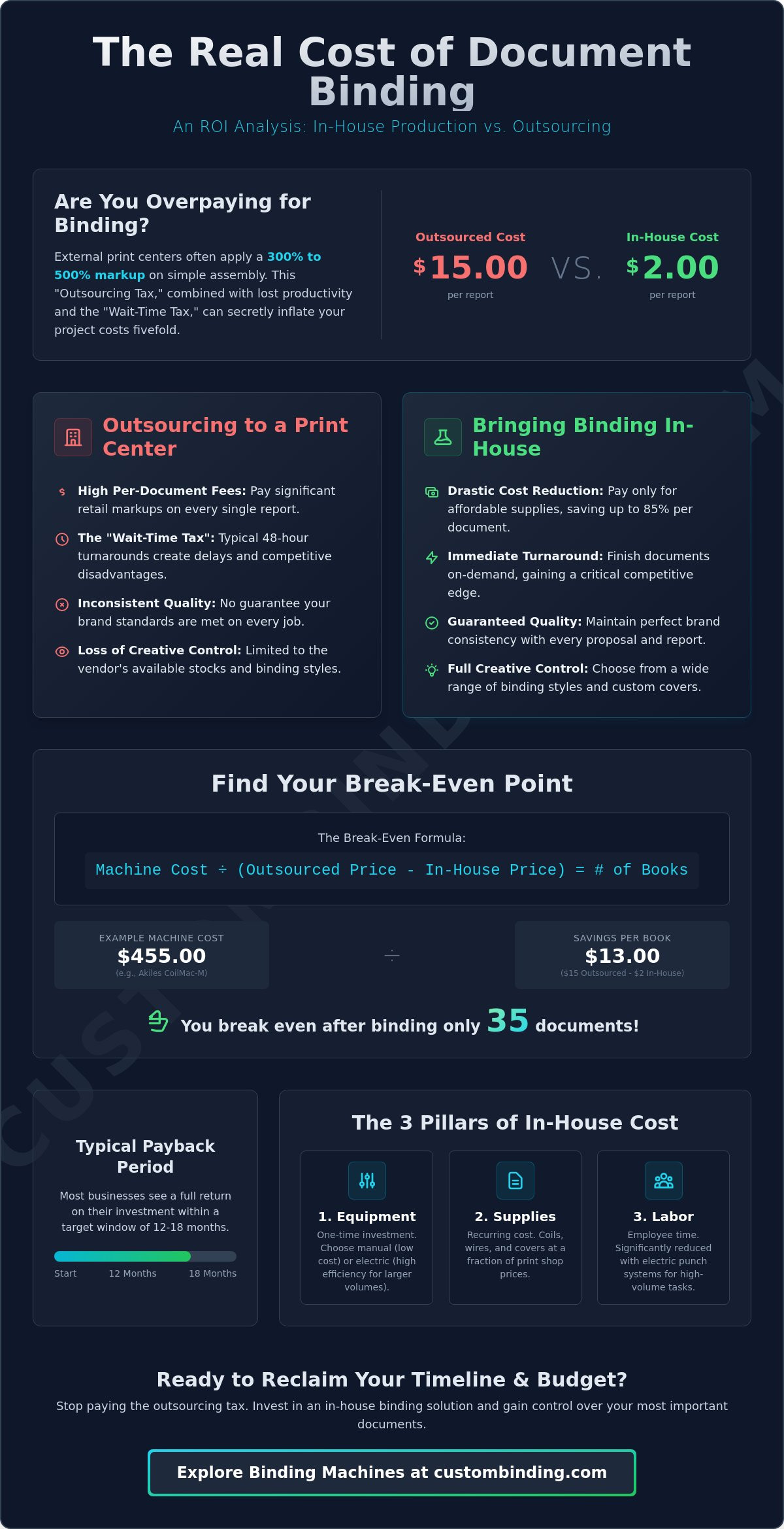
Realizing a return on investment for office equipment usually involves a slow crawl of depreciation and incremental productivity gains. Document finishing is different. We define Binding ROI as the specific calendar date when the cumulative savings from in-house production exceed the total purchase price of your equipment. Because professional print centers often apply a 300% to 500% markup on simple assembly tasks, a binding machine frequently pays for itself faster than almost any other piece of office technology.
To calculate your potential savings, you must analyze three primary variables: your average monthly document volume, the current retail price you pay for outsourcing, and your internal labor rate. While "Hard ROI" focuses on these tangible dollar amounts, you should also consider "Soft ROI." This includes the immediate boost to your brand image when you present a perfectly bound proposal and the hours saved by eliminating trips to a local print shop. Understanding the process of bookbinding helps you see why these machines are such high-value assets; they take a complex manual craft and turn it into a streamlined, one-button business process.
The Break-Even Point Formula
Determining your timeline is a matter of simple mathematics. Use this formula: Machine Cost / (Outsourced Price per Book - In-House Supply Cost per Book) = Number of Books to Break Even.
Imagine a San Diego consulting firm that produces 40 quarterly reports. If a local print center charges $15.00 per report and in-house supplies cost roughly $2.00, the firm saves $13.00 per document. If they invest in a professional system like the Akiles CoilMac-M, they could reach their break-even point in just a few months. The "Payback Period" is the definitive window of time required for an investment to generate enough cash flow to recover its initial cost.
Why 2026 is the Year to Bring Finishing In-House
Current economic shifts in San Diego emphasize lean operations and maximum office efficiency. As commercial real estate costs fluctuate, businesses are looking to maximize the output of their existing footprint. Local "on-demand" printing services have increased their rates to cover rising overhead, making the "Outsourcing Tax" more expensive than ever.
An ROI calculator for buying a binding machine often reveals that the convenience of immediate turnaround is worth more than the equipment itself. In 2026, waiting 48 hours for a vendor to finish a project isn't just a nuisance; it's a competitive disadvantage. Bringing finishing in-house ensures that your most important client meetings are never delayed by a third-party schedule. This immediate availability creates a sense of momentum that external vendors simply cannot match.
The 3 Pillars of Binding Cost: Equipment, Supplies, and Labor
A comprehensive ROI calculator for buying a binding machine must look beyond the sticker price of the equipment. To understand the true fiscal impact, you need to analyze the "Three Pillars" of finishing: the initial machinery investment, the recurring cost of consumables, and the labor burden of production. Failing to account for any of these factors will result in an incomplete financial picture that could skew your payback period projections.
Machinery Costs: Upfront vs. Long-Term
The choice between a manual system like the Akiles CoilMac-M and a heavy-duty electric punch like the Rhin-O-Tuff Onyx HD7700 depends entirely on your projected output. Manual machines offer a lower entry point for low-volume offices, but they require more physical effort and time per document. Electric systems increase your upfront cost; however, they significantly reduce the time spent per book, which is critical for high-volume runs of 100 documents or more. Professional-grade machines from brands like GBC or Tamerica also retain a high resale value, often trading for a significant portion of their original price on the secondary market. In contrast, "budget" machines often lack the precision of hardened steel dies, leading to misaligned holes and wasted materials that drain your ROI over time.
The Consumable Math: Coils, Wires, and Covers
Consumables are where the "Outsourcing Tax" is most visible. While a print shop might charge several dollars for a single coil and cover set, your internal cost is a fraction of that. Plastic spiral binding coils are the most cost-effective option for high-volume internal reports, while twin loop binding wire offers a premium aesthetic for client-facing presentations. Pairing these with Regency Composition Covers or clear acetate covers provides a professional finish that rivals any external vendor. By sourcing your binding supplies in bulk, you can lower your per-unit cost significantly. Local businesses in San Diego benefit from reduced shipping times on heavy items like roll laminating film and bulk wire spools, further accelerating the return on your equipment investment.
Labor is the final, and often most overlooked, pillar. According to the Bureau of Labor Statistics, the mean hourly wage for print binding and finishing workers is approximately $18.68. If an employee can bind 50 books in two hours using an efficient system like the GBC CombBind C800pro, your labor cost is less than $1.00 per book. When you compare this to the $5.00 to $10.00 per-book markup charged by retail centers, the financial advantage of in-house production becomes undeniable. High-durability systems like those from Rhin-O-Tuff require a small maintenance reserve, but their mechanical reliability ensures that your "Downtime ROI Loss" remains at a minimum.
In-House Binding vs. Outsourcing: The Hidden Cost Analysis
Outsourcing your document finishing involves more than just a line item on an expense report. It introduces a series of logistical frictions that can erode your team's productivity and your firm's professional image. When you use an ROI calculator for buying a binding machine, you must account for the substantial retail markups and the "Lead Time Cost" that external vendors impose on every project. Relying on a third party means you're paying for their overhead, their labor, and their profit margin, all while losing control over your own delivery schedule.
Retail Pricing Reality Check
In the San Diego market, a standard 50-page coil-bound report typically carries a retail price between $12.00 and $18.00 at major print centers. This price often includes a "Small Batch Penalty," where low-volume orders are subject to higher unit costs or mandatory setup fees. In contrast, producing that same document in-house using Plastic Spiral Binding Coils and Clear Acetate Covers costs roughly $1.50 when you factor in both supplies and labor. This 1,000% markup is the primary reason why in-house finishing offers such a rapid payback period. Beyond the direct cost, consider the "Travel and Wait Time." Sending an employee to a local shop for a 20-minute round trip plus waiting in line effectively doubles the labor cost of that single document.
The Value of Tactical Flexibility
The most significant hidden cost of outsourcing is the loss of agility. If a partner discovers a typo ten minutes before a critical board meeting, an outsourced document is a permanent liability. With in-house equipment like the Tamerica Optimus-450, you can perform last-minute edits and re-bind a corrected version in seconds. This tactical flexibility allows you to personalize presentations for specific stakeholders, swapping out Regency Composition Covers to match a client's brand colors or adjusting the content for a specific pitch. Professional finishing directly impacts client win rates by signaling that your firm is organized, detail-oriented, and fully in control of its output. An ROI calculator for buying a binding machine proves that the ability to bound a document in 10 minutes rather than waiting 24 hours is a measurable competitive advantage.
External vendors also introduce a risk of inconsistent quality. A misaligned punch or a scuffed cover from a high-volume retail shop can undermine your professional credibility. When you handle finishing in-house, your team maintains total oversight of the tactile experience. You ensure every Twin Loop Binding Wire is closed perfectly and every page is trimmed accurately using Dahle Professional Rolling Trimmers. This level of quality control prevents the need for expensive "re-dos" and ensures that your first impression is always a flawless one.
Payback Period: How Fast Will Your Machine Pay for Itself?
Timing is everything in business. When you invest in professional-grade equipment, you aren't just buying a tool; you're securing a predictable expense model for years to come. Most businesses aim for a payback period of 12 to 18 months, but your actual timeline depends heavily on your production volume. Utilizing an ROI calculator for buying a binding machine allows you to visualize exactly when your equipment stops being an expense and starts being a source of pure savings.
Low Volume ROI: Is a Manual Machine Enough?
Small San Diego law firms or boutique agencies typically produce between 1 and 20 documents per month. For this volume, a manual system like the Akiles CoilMac-M is often the most logical choice. It offers a low entry cost while maintaining professional standards. However, avoid the "Entry Level" trap of purchasing flimsy, consumer-grade machines found at big-box retailers. These low-quality units often lack the torque to punch through Regency Composition Covers, leading to document waste and employee frustration. By choosing a durable manual machine, you can keep your payback period under six months, even with modest monthly usage.
High Volume ROI: The Case for Automation
If your office produces more than 100 books monthly, manual punching becomes a bottleneck that drains productivity. This is where high-performance systems like the Rhin-O-Tuff Onyx HD7700 prove their worth. While the initial investment is higher, the labor savings are immense. An electric punch can handle three to four times the page volume of a manual lever in the same amount of time. When you factor in the $18.68 mean hourly wage for finishing workers, the reduction in man-hours alone can pay for the machine upgrade within the first year. Industrial equipment also offers a superior 5-year ROI because it's built to withstand hundreds of thousands of cycles without precision loss.
Laminating needs follow a similar financial logic. In school settings or busy marketing departments, the Tamerica Optimus-450 roll laminator pays for itself by replacing expensive laminating pouches with more cost-effective Roll Laminating Film. The shift from individual pouches to a continuous roll system can slash material costs by 40% or more.
To help you estimate your own timeline, consider these typical San Diego office benchmarks:
- Low Volume (10-15 books/mo): 5-8 month payback with a manual machine.
- Mid Volume (30-50 books/mo): 10-12 month payback with an electric inserter.
- High Volume (100+ books/mo): 14-18 month payback with an industrial electric punch.
Ready to stop overpaying for external finishing and start building your in-house production center? Browse our selection of professional binding machines to find the perfect fit for your office volume.
Maximizing ROI with Custom Binding Products in San Diego
The final calculation in any ROI calculator for buying a binding machine isn't just about the purchase price; it's about the machine's lifespan and the reliability of your supply chain. Since 1988, we've helped San Diego businesses move beyond generic estimates to realize actual, measurable savings. Choosing a local partner ensures that your investment continues to perform long after the initial setup. This professional partnership transforms a simple equipment purchase into a long-term strategy for operational efficiency.
Local Support: The ROI Safety Net
A machine that sits idle due to a mechanical fault has a negative ROI. While global vendors might require you to ship heavy equipment across the country for service, Custom Binding Products provides on-site maintenance that minimizes your equipment downtime. This immediate response prevents "Downtime ROI Loss," where your team is forced back into expensive retail outsourcing while waiting for a repair. Regular servicing also extends the life of your GBC CombBind C800pro or Akiles CoilMac-M, protecting your capital investment for the long haul. If you notice issues with your heat settings or film feed, checking for the "5 Signs Your Laminator Needs Repair" can help you catch small problems before they become costly failures.
Wholesale Supplies and Bulk Savings
Shipping costs for heavy materials like Twin Loop Binding Wire or bulk boxes of Plastic Spiral Binding Coils can significantly inflate your per-document cost. By utilizing local pickup in San Diego, you eliminate these fees entirely. This logistical advantage allows you to purchase premium Regency Composition Covers and Clear Acetate Covers at wholesale rates without the shipping surcharge. These high-quality materials don't just look better; they reinforce your professional image with every proposal you deliver. Buying in bulk from a local vendor ensures your supply cabinet is always stocked, preventing the emergency retail runs that drain your budget.
Selecting the right equipment is the most critical factor in your payback period. An overpowered machine for low volume is a waste of capital, while a manual punch for high-volume tasks drains labor resources. Our specialists provide the expert consultation needed to match your specific workflow with the right tool, whether it's a Martin Yale Paper Folder or a Dahle Professional Rolling Trimmers. This precision ensures you achieve the exact break-even point you projected. Contact us today to request a custom ROI quote tailored to your specific document volume and finishing needs.
Take Control of Your Professional Presentation Costs
Transitioning to in-house finishing is a strategic move that protects both your budget and your professional brand. By eliminating the high retail markups and unpredictable lead times of external vendors, you ensure that every document reflects your firm's exact standards. You now understand how the three pillars of cost; equipment, supplies, and labor; work together to determine your break-even point. Whether you're producing small batches or high-volume reports, the math consistently favors ownership over the "Outsourcing Tax."
Using a precise ROI calculator for buying a binding machine reveals that most professional systems pay for themselves in less than 18 months. Custom Binding Products has served the San Diego business community since 1988, offering the expert on-site repair and wholesale pricing you need to maintain peak efficiency. We're ready to help you select the ideal system for your unique workflow and volume.
Get a Professional ROI Consultation for Your San Diego Office and empower your team with the tools they need to produce flawless results today.
Frequently Asked Questions
How do I calculate the labor cost for in-house binding?
Calculate your labor cost by dividing the employee's hourly wage by the number of documents they can finish in one hour. For example, if a staff member earns $18.68 per hour and completes 30 books, your labor cost is approximately $0.62 per unit. Using an ROI calculator for buying a binding machine helps you visualize how even small improvements in speed can significantly lower your total production expense.
What is the average lifespan of a professional binding machine?
High-quality professional machines from brands like Rhin-O-Tuff or Akiles typically last 10 to 15 years with regular maintenance. These systems feature hardened steel dies and heavy-duty motors designed for industrial use, unlike consumer-grade plastic units. Investing in a durable system ensures your equipment remains a productive asset long after the initial payback period is complete.
Is it cheaper to use coil binding or comb binding for high-volume reports?
Comb binding supplies like those used with the GBC CombBind C800pro generally have a lower per-unit material cost than plastic spiral coils. However, coil binding often yields a higher ROI for high-volume projects because an electric inserter allows for faster assembly. You should weigh the slight increase in supply cost against the substantial labor savings gained from a faster production rhythm.
Does the ROI change if I use clear acetate covers vs. standard cardstock?
Yes, your ROI often improves when using premium materials like clear acetate covers or Regency Composition Covers. Retail print centers apply their highest markups to these "specialty" items, sometimes charging three to five times the wholesale cost. By purchasing these professional covers at wholesale rates, you widen the gap between in-house costs and outsourcing fees, accelerating your break-even point.
How much can a San Diego business save by picking up supplies locally?
Local businesses save money by eliminating the high shipping surcharges associated with heavy items like bulk wire spools or roll laminating film. Heavy-duty supplies are expensive to transport across the country, often adding 15% to 20% to the total order cost. Picking up your materials directly from a local specialist ensures your ROI calculations remain accurate and free from hidden logistics fees.
Should I buy a used binding machine to improve my initial ROI?
Buying used equipment carries the risk of hidden mechanical wear or misaligned punching dies that can ruin expensive documents. While the lower upfront price is tempting, the lack of a warranty and the potential for "Downtime ROI Loss" often makes new equipment a safer investment. A new machine provides predictable performance and access to expert support, ensuring your finishing process stays on schedule.
Does electric punching really save enough time to justify the extra cost?
Electric punching is essential for any office producing more than 50 documents per month. A system like the Rhin-O-Tuff Onyx HD7700 allows an operator to punch thousands of sheets per hour without the physical fatigue associated with manual levers. This increased efficiency reduces the labor burden per book, which is a critical variable in any ROI calculator for buying a binding machine.
How do I factor in the cost of laminating film when calculating total finishing ROI?
Factor in laminating costs by calculating the price per square foot of roll laminating film compared to the retail price of a finished laminated sheet. Systems like the Tamerica Optimus-450 are significantly more cost-effective than using individual laminating pouches for large projects. This material savings, combined with the ability to trim documents precisely with Dahle Professional Rolling Trimmers, provides a comprehensive view of your total finishing value.