
Binding Machine Maintenance Checklist: The 2026 Professional Guide
A jagged punch or a misaligned coil on a high-stakes proposal does more than waste paper; it quietly erodes the professional authority you've worked so hard to build. You already know that the tactile quality of your documents serves as a physical handshake with your clients. It's frustrating when mechanical issues like paper jams or motor strain turn a routine assembly into a source of deadline anxiety. This 2026 professional guide provides a definitive binding machine maintenance checklist designed to protect your equipment investment and ensure every document reflects a standard of excellence.
By following this framework, you'll extend the lifespan of your Akiles or Rhin-O-Tuff hardware while maintaining a consistent, professional-grade finish. We'll examine essential daily habits, lubrication schedules, and critical OSHA safety standards, including 29 CFR 1910.212 for machine guarding and 29 CFR 1910.147 for energy control. This methodical approach removes the friction from your finishing process, allowing you to focus on the storytelling within the pages rather than the mechanics of the bind. We've organized these steps to help you avoid costly downtime and keep your production running with the quiet confidence of a well-oiled machine.
Key Takeaways
- Understand how systematic cleaning and lubrication prevent document "burring" and preserve the crisp, professional aesthetic of your bound presentations.
- Implement a daily binding machine maintenance checklist to manage waste tray levels and inspect punch pins, effectively preventing back-pressure jams during high-volume projects.
- Master the mechanical nuances of different systems, from maintaining the grip on spiral coil rollers to ensuring the closing jaws of wire binders remain perfectly parallel.
- Learn to identify early warning signs of mechanical strain, such as unusual motor humming or incomplete pin retraction, to address issues before they cause significant downtime.
- Determine exactly when to transition from routine in-house care to professional on-site service to protect your equipment investment and ensure reliable performance.
Why Binding Machine Maintenance is Critical for Professional Results
Professional document finishing relies on the mechanical precision of your equipment. Binding machine maintenance is the systematic cleaning, lubrication, and inspection of punch dies and insertion mechanisms. It's a proactive strategy that ensures every document you produce meets a high standard of quality. When you treat your equipment as a professional asset rather than a simple utility, you protect the integrity of your brand's physical output.
While the historical process of building a book involves intricate manual labor, modern office binding focuses on mechanical consistency. Implementing a consistent binding machine maintenance checklist prevents common aesthetic failures like "burring," where dull punch pins leave ragged paper fibers around the holes. These small imperfections can make even the most sophisticated report look amateurish and unpolished.
Neglecting these components leads to more than just poor aesthetics; it carries a heavy financial burden. A five-minute daily inspection is a minor investment of time compared to the significant expense of a motor replacement. For owners of high-end systems from brands like Rhin-O-Tuff or Akiles, documented maintenance is often a requirement for upholding warranty claims. By keeping a log of your care routine, you ensure that your investment remains protected under the manufacturer's terms.
The ROI of Preventative Care
Financial efficiency starts with extending the duty cycle of your equipment. Heavy-duty binders, such as the Rhin-O-Tuff Onyx HD7700, are designed for high-volume environments, but paper dust creates internal friction that forces electric motors to work harder. Regular cleaning reduces this strain and prevents premature burnout. Additionally, a well-maintained machine eliminates the need for "test punches," which reduces the waste of expensive consumables. You'll spend less on ruined covers and coils while maintaining the high resale value of your professional-grade hardware.
Impact on Professional Presentation
The physical quality of a presentation is a tactile experience for your client. Crisp, clean edges on Clear Acetate Covers or Regency Composition Covers signal attention to detail and organizational pride. If your punch pins are dull or misaligned, they can drag through the material rather than cutting it, creating a rough texture that's immediately noticeable to the touch. A specialist's approach to maintenance ensures that the mechanical movement of your components remains fluid, resulting in a finished product that reflects the superior quality of your business.
The Essential Binding Machine Maintenance Checklist
Maintaining professional standards requires a rigorous binding machine maintenance checklist that segments tasks by frequency. This structured approach prevents minor debris from escalating into mechanical failure. A high-performance environment demands more than occasional care; it requires a steady cadence of inspection and cleaning to ensure every document you produce is flawless.
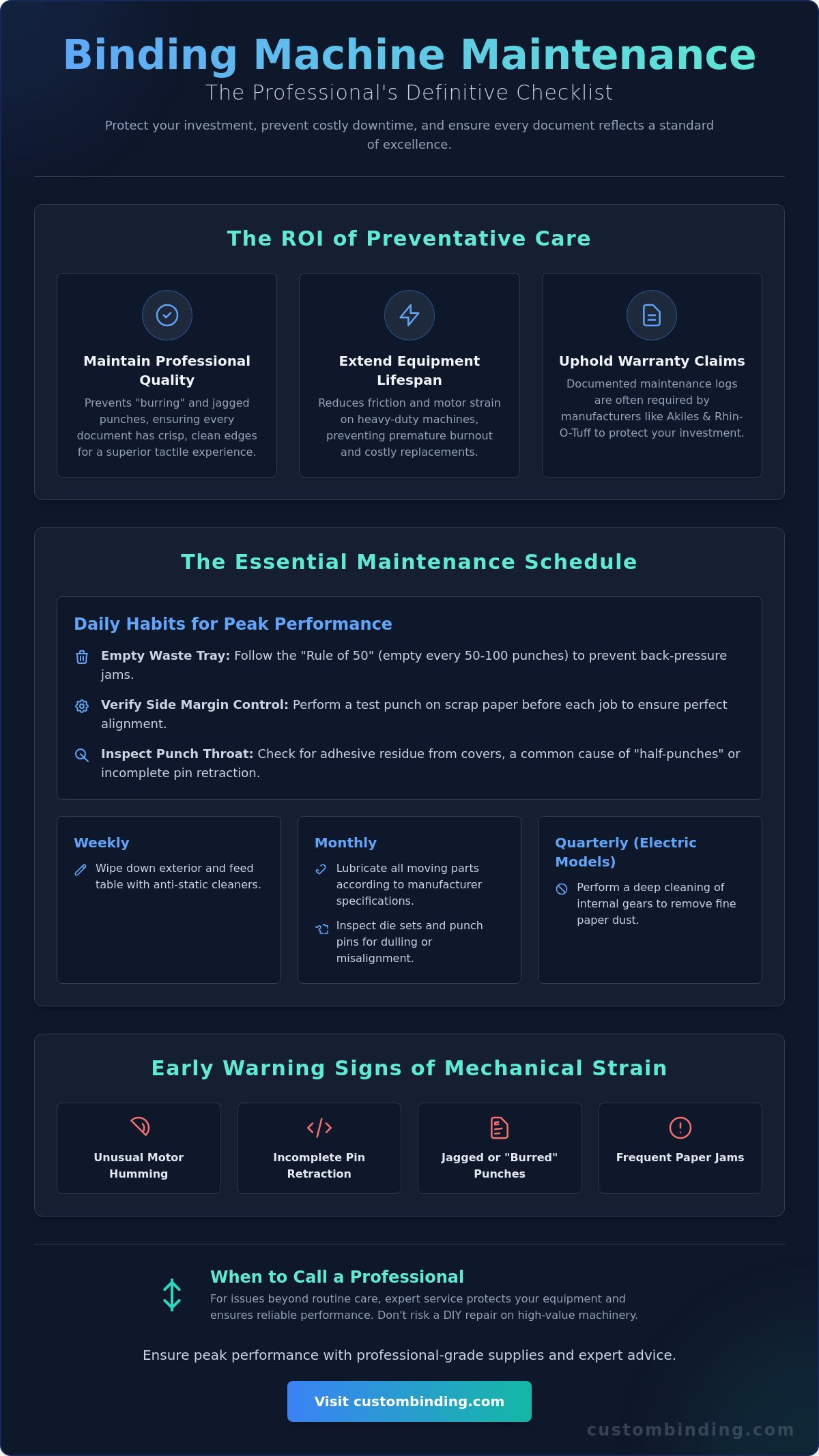
Daily habits form the foundation of equipment longevity. You must empty the waste tray at the start of every shift to prevent back-pressure jams. When paper chips accumulate, they can force their way back into the punch throat, bending pins or causing the motor to seize. Weekly, use anti-static cleaners to wipe down the feed table and exterior. This prevents static buildup that leads to misfeeds and crooked punches. Monthly, focus on lubricating moving parts and inspecting die sets for signs of dulling or misalignment. For electric models like the GBC CombBind C800pro, a quarterly deep cleaning of internal gears is necessary to remove fine paper dust that bypasses the primary waste system.
Daily Habits for Peak Performance
Adopt the "Rule of 50" by emptying the waste tray every 50 to 100 punches. This habit is especially critical when working with dense materials like Regency Composition Covers, which produce larger, heavier chips. Before starting any job, verify the side margin control. A quick test punch on scrap paper ensures your document is perfectly centered every time. If your workflow involves pre-glued covers, inspect the punch throat for adhesive residue. Sticky buildup on the pins is a common cause of "half-punches" where the pins fail to retract fully.
Monthly Deep Care Procedures
Keep your punch pins moving fluidly by using wax-based lubricants or oil-impregnated paper. Avoid standard liquid oils that can seep into your documents and ruin the professional finish. During this monthly service, carefully inspect the "bite" of the punch. If you notice the machine requires more force or the paper edges appear fuzzy, the dies may need professional sharpening. Safety is just as important as performance, so test the responsiveness of the foot pedal and emergency stop on your electric units. For more specific insights on maintaining different punch styles, you can review this guide on How to Maintain Comb Binding Equipment. If you find that your equipment is still struggling after these steps, it's a good idea to consult a specialist for a professional calibration.
Maintenance Requirements for Specific Binding Systems
Every binding style presents unique mechanical challenges that a generic routine cannot fully address. To maintain a professional-grade finish, your binding machine maintenance checklist must account for the specific hardware components of your chosen system. Whether you utilize the continuous spiral of a plastic coil or the sophisticated closure of twin loop wire, each mechanism requires targeted care to prevent document failure.
Plastic coil binding relies heavily on the friction and grip of electric roller inserters. Over time, paper dust and oils from your hands accumulate on these rubber rollers, causing the coil to slip or spin in place without advancing. Similarly, twin loop wire binding depends on the absolute precision of the closing "jaw." If this jaw isn't perfectly parallel, your wire loops will appear crushed on one end and loose on the other, undermining the tactile quality of your presentation. Plastic comb systems and thermal binders also have distinct needs, from the lubrication of opening "fingers" to the cleanliness of heating elements that ensure even adhesive distribution.
Coil Binding Specifics (Akiles & Rhin-O-Tuff)
High-performance units like the Akiles CoilMac-M or the Rhin-O-Tuff Onyx HD7700 require pristine rollers to function at peak capacity. Use a lint-free cloth dampened with a small amount of isopropyl alcohol to clean the rubber rollers weekly. This restores the "tack" needed for the electric inserter to grip the Plastic Spiral Binding Coils effectively. Always verify your punch pitch before starting a project. A 4:1 pitch punch must match a 4:1 coil; forcing a mismatch causes motor strain and ruins the document. Don't overlook your manual crimper pliers. These tools are the most neglected part of the coil process. A drop of wax-based lubricant on the pivot point ensures they cut and crimp cleanly, providing that critical final aesthetic detail.
Wire and Comb Mechanism Care
Precision is the hallmark of twin loop wire binding. You must calibrate the "Wire Closer" regularly to ensure it stops at the exact diameter of the wire you're using. If the closer is out of alignment, the Twin Loop Binding Wire won't secure the pages properly, leading to a loose, unprofessional feel. For comb binding, plastic shavings often migrate into the comb opener mechanism. These small fragments cause the "fingers" to snag or stutter during insertion. If you're using a GBC CombBind C800pro, perform monthly tension checks on the opening handle. If the handle feels spongy or fails to hold the comb open fully, it often indicates that internal springs require adjustment or cleaning. These specialized steps ensure your equipment remains a reliable partner in your professional success.
Troubleshooting Common Mechanical Issues and Jams
Mechanical friction is an inevitable reality in high-volume production environments. Even when you follow a rigorous binding machine maintenance checklist, the interaction between steel punch pins and various paper stocks can occasionally lead to operational hurdles. Promptly identifying these symptoms allows you to intervene before a minor jam escalates into a costly repair or a ruined project. Addressing these issues with a methodical approach preserves the tactile quality of your presentations and keeps your workflow moving without interruption.
One of the most frequent challenges is the "half-punch" problem, where pins fail to retract fully after a cycle. This typically occurs when adhesive residue from pre-glued covers or static electricity causes paper fibers to cling to the pins. You can often resolve this by punching through a sheet of wax paper to lubricate the die or using anti-static sprays to neutralize the charge in the punch throat. Additionally, if you notice a deep "hum" coming from your electric binder, it's a clear signal of motor strain. This sound suggests you are exceeding the sheet capacity for that specific lift. Immediately reduce the number of pages to prevent the motor from overheating or blowing an internal fuse.
Clearing Stubborn Jams Safely
When a punch cycle stops mid-stroke on electric models like the Rhin-O-Tuff Onyx HD7700, utilize the "Reverse" trick. Most professional units feature a manual or electric reverse switch that backs the pins out of the paper stack safely. Never use metal tools, such as screwdrivers or letter openers, to dig out paper chads from the die. Metal-on-metal contact will score the punch pins and permanently ruin the "bite" of the machine. Instead, use a stiff plastic shim or a piece of heavy Regency Composition Cover to gently nudge the blockage. If your machine, such as the Akiles CoilMac-M, features disengageable pins, pull out the pin corresponding to the jam to isolate and clear the area without affecting the rest of the die set.
Identifying Wear vs. User Error
Distinguishing between a mechanical failure and simple user error is critical for maintaining equipment longevity. We recommend the "20% Rule": consistently punch 20% fewer sheets than the manufacturer’s maximum rated capacity. This buffer reduces the load on the internal gears and significantly extends the life of the electric motor. If you hear a sharp "clunking" sound rather than a smooth mechanical slide, it often indicates a broken internal spring or a misaligned gear rather than a simple jam. Many of these mechanical stressors can be avoided through proper operator education. Ensuring your team understands how to use a binding machine correctly is the most effective way to reduce service calls. If these troubleshooting steps do not restore your machine's smooth operation, it is time to schedule a professional diagnostic to protect your investment.
When to Call the Professionals: San Diego Equipment Service
Even with a rigorous binding machine maintenance checklist, mechanical parts eventually require a specialist's touch. Recognizing the limits of in-house care is essential for protecting your equipment investment. If you experience persistent jagged edges on your Regency Composition Covers or detect a faint burning smell during a high-volume run, stop operation immediately. These symptoms suggest that your punch pins need professional sharpening or that the electric motor is nearing a critical failure point. Continuing to force a malfunctioning unit will only increase the eventual repair cost and potentially ruin your reputation for quality.
Our team provides specialized repair services for industry-leading brands including Rhin-O-Tuff, Akiles, and GBC. We understand that for San Diego businesses, document preparation is often tied to strict deadlines. Shipping a heavy-duty binder like a Rhin-O-Tuff Onyx HD7700 for repair is logistically difficult and risks transit damage. Don't let a minor mechanical glitch turn into a total production halt. Our on-site service model eliminates these headaches by bringing our expertise directly to your facility. For high-volume environments, transitioning from reactive repairs to a formal maintenance contract ensures your equipment remains in peak condition year-round.
Expert Repair for San Diego Organizations
With over 35 years of experience servicing commercial binding equipment in San Diego, we've developed a deep understanding of mechanical durability. While some users try DIY sharpening methods, professional die sharpening is superior because it ensures every pin is ground to the exact same tolerance. This precision prevents an uneven "bite" and extends the life of the entire die set. Our technicians provide the steady hand needed in a busy professional environment. We come to your San Diego location to save you from the logistics headaches of shipping heavy machinery and to ensure your tactile presentations remain flawless.
Upgrading vs. Repairing
There comes a point where the cost of repair outweighs the value of an aging machine. If your Tamerica or GBC unit is over a decade old and requires frequent part replacements, it's likely time to evaluate a newer model like the Tamerica Optimus-450. We offer a distinct "Trade-In" advantage that helps you level up to modern, more efficient hardware while reducing your initial capital outlay. This strategic approach ensures your office always has reliable tools for professional storytelling. It's a partner-focused solution that values your brand's image as much as you do. Schedule your San Diego on-site equipment repair today.
Secure Your Professional Reputation Through Equipment Care
Maintaining the mechanical integrity of your binding equipment is a direct investment in your brand's professional image. Crisp punches and perfectly aligned wires don't happen by chance; they are the result of a disciplined approach to hardware care. By integrating this binding machine maintenance checklist into your daily operations, you eliminate the friction of production delays and ensure every document serves as a high-quality physical handshake with your clients. Whether you're managing a heavy-duty Rhin-O-Tuff system or a precision Akiles unit, consistent care preserves the tactile experience your audience expects.
When internal mechanical issues exceed the scope of routine cleaning, partner with a specialist who understands the nuances of your machinery. We've been serving the San Diego business community since 1988 as an authorized dealer for Akiles, Rhin-O-Tuff, and GBC. Our expert on-site technical support removes the logistical burden of repairs, allowing you to stay focused on your core professional goals. Keep your equipment in peak condition with Custom Binding Products and enjoy the confidence that comes with a well-oiled production process. Your commitment to quality today ensures flawless presentations for years to come.
Frequently Asked Questions
How often should I oil my binding machine punch pins?
You should lubricate your punch pins once a month or every 10,000 cycles to maintain mechanical fluidity. Use wax-based lubricants or specialized oil-impregnated paper rather than liquid oils. This practice is a core part of any binding machine maintenance checklist to prevent paper fibers from clinging to the steel pins and causing friction during high-volume jobs.
Why is my binding machine punching 'fuzzy' or jagged holes?
Fuzzy or jagged holes, often called "burring," typically indicate that your punch pins are dull or that paper dust has accumulated in the die set. This issue is most noticeable on dense materials like Regency Composition Covers. If cleaning the die doesn't restore a crisp edge, your pins likely require professional sharpening to regain their precision bite.
Can I use WD-40 to lubricate my binding machine?
No, you should never use WD-40 or similar household solvents on professional binding equipment. These products are designed to displace moisture and can attract paper dust, which creates a gritty paste that accelerates mechanical wear. Additionally, these oils can seep into your Clear Acetate Covers and ruin the professional aesthetic of your final presentation.
What should I do if the punch handle on my manual binder is stuck?
Stop applying pressure immediately to avoid bending the internal linkage or breaking a punch pin. First, verify that the waste tray is empty, as back-pressure from a full tray is the most common cause of a stuck handle. If the tray is clear, inspect the punch throat for adhesive residue or a "half-punch" where a pin has failed to retract fully.
Is it normal for my electric binding machine to smell like it's burning?
A burning smell is never normal and indicates that the electric motor is under significant strain or that paper dust has reached the internal heating elements. This often happens when you exceed the sheet capacity of units like the GBC CombBind C800pro. Power down the machine immediately and contact a specialist to prevent permanent motor damage.
How do I know if my punch dies need to be sharpened or replaced?
You'll know your dies need professional attention when you notice increased resistance during the punch cycle or visible tearing on the bottom sheets of a stack. If you consistently follow a binding machine maintenance checklist and still experience poor hole quality, the steel has likely lost its temper. Professional sharpening is a cost-effective way to restore factory-level performance.
Do you offer on-site binding machine repair in San Diego County?
Yes, we provide expert on-site technical support throughout San Diego County for all major brands, including Rhin-O-Tuff and Akiles. Our technicians bring the necessary tools and parts directly to your office to minimize downtime. This service is designed for organizations that prioritize efficiency and want to avoid the logistical risks of shipping heavy machinery.
Can I punch plastic covers and paper at the same time?
It's best to punch plastic covers separately from your paper stock to ensure a clean, professional finish. Plastic materials like Clear Acetate require different punching pressure than standard paper. Punching them together can lead to misaligned holes and puts unnecessary strain on the punch pins, which shortens the lifespan of your equipment.
Recent Posts
-
Upgrading Your Office Binding System: The 2026 Professional Guide
Did you know that switching from a manual punch to an electric binding machine can save your team …Jun 27th 2026 -
Professional Wire Binding Supplies in San Diego: Your 2026 Essential Guide
Imagine handing a potential client a thick, high-value report, only for the pages to snag because …Jun 26th 2026 -
Best Binding Method for Professional Reports: A 2026 Executive Guide
The physical feel of your document often speaks louder than the data on the page. In a high-stakes …Jun 25th 2026