
Coil Binding vs Wire Binding for Professional Documents: The 2026 Guide
May 23rd 2026
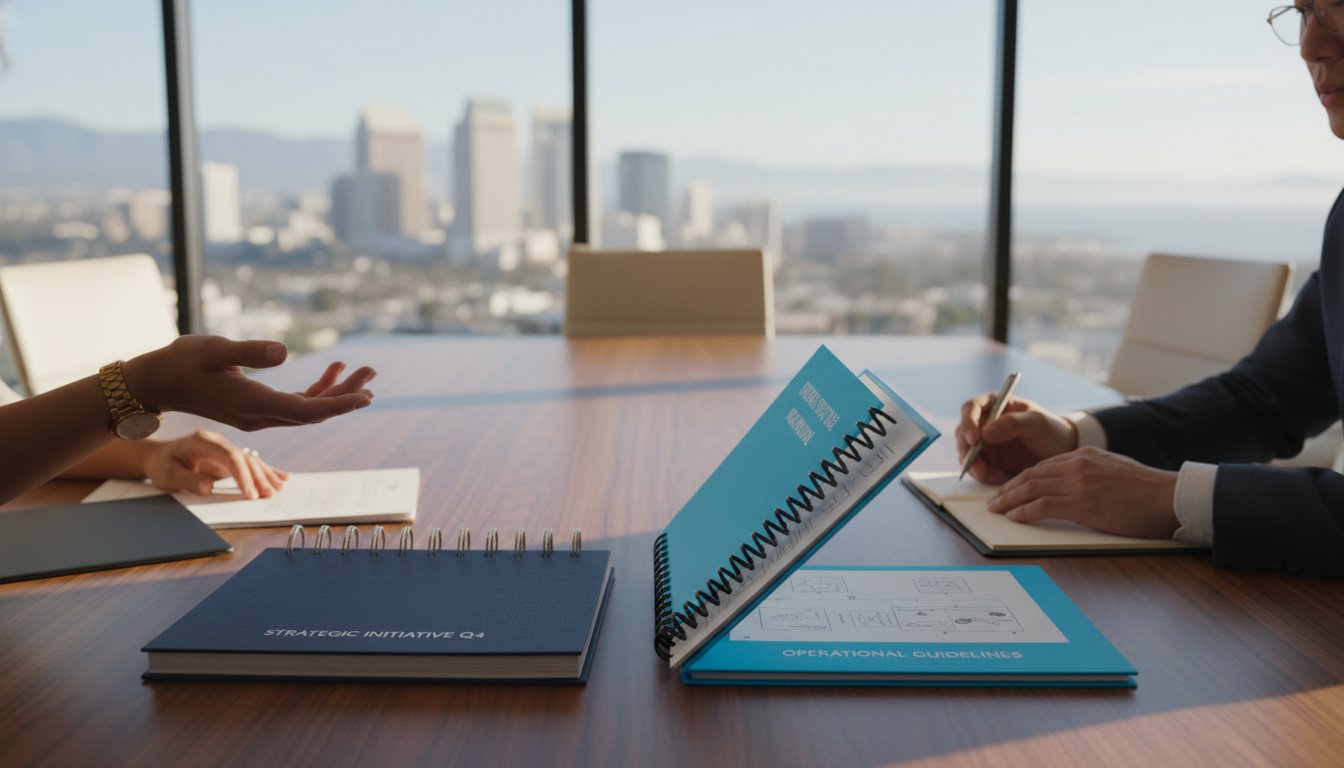
Your client’s first impression of your firm happens before they read a single word of your proposal. It’s the tactile experience of the document spine in their hand that sets the tone for the perceived value of your work. You likely feel the sting of paying high markups at local print shops only to receive documents that don't survive a trip through the mail or look unprofessional in a high-stakes meeting. Mastering the choice between coil binding vs wire binding for professional documents is ultimately a decision between "Desk-Life" utility and "Boardroom-Life" aesthetics.
This 2026 guide promises to help you understand these functional differences to elevate your presentation and protect your reputation. You'll learn how to achieve a polished finish and produce durable documents that withstand frequent use. We'll show you how bringing production in-house with equipment like the Akiles CoilMac-M or the Rhin-O-Tuff Onyx HD7700 can lower your cost-per-unit while ensuring every report you deliver is boardroom-ready. We'll compare everything from page capacities to the specific visual impact of twin loop wire versus plastic spiral coils.
Key Takeaways
- Identify when to prioritize the sophisticated, metallic finish of Twin Loop Wire for executive proposals and high-stakes boardroom presentations.
- Understand why the 360-degree rotation and durability of plastic spiral coils make them the superior choice for functional manuals and daily reference guides.
- Evaluate mailing and storage logistics to ensure your bound documents arrive undamaged and stack efficiently in a professional environment.
- Master the functional and aesthetic differences of coil binding vs wire binding for professional documents to justify the ROI of bringing production in-house.
- Select the right combination of professional equipment and premium covers to eliminate local print shop markups and maintain total control over your brand’s tactile identity.
Defining the Professional Standard: Coil and Wire in the Modern Office
Every document you hand to a client serves as a silent ambassador for your brand. When deciding between coil binding vs wire binding for professional documents, you aren't just choosing a mechanical fastener; you're selecting the physical interface of your intellectual property. Modern bookbinding methods have evolved significantly, allowing local offices to produce results that once required a commercial press. This shift toward high-quality, in-house finishing allows firms to maintain total control over their presentation standards while reducing the high costs associated with print shop markups.
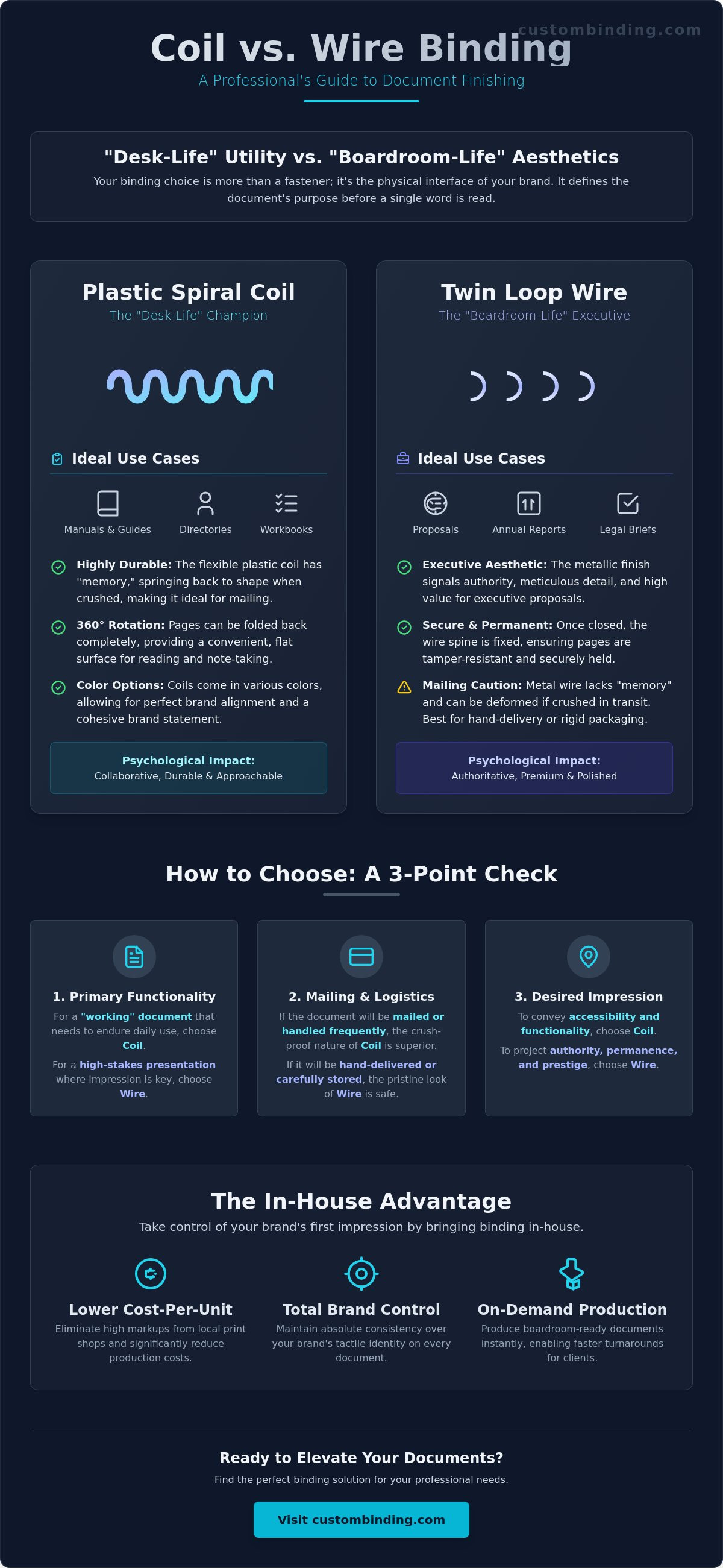
Twin Loop Binding Wire consists of pre-formed metal loops that a machine closes into a permanent, circular spine. It offers a sophisticated, high-end feel that remains fixed once assembled. Plastic Spiral Binding Coils use a durable, continuous filament that winds through the document. This choice creates a flexible spine that maintains its shape even after heavy use. We categorize these choices into two distinct life cycles: "Desk-Life" and "Boardroom-Life." Desk-Life documents require the resilience of plastic spirals to survive daily handling, while Boardroom-Life documents demand the sleek, metallic elegance of twin loop wire to command respect during a high-stakes presentation.
The Psychology of Document Finishing
The weight and material of a document spine trigger immediate psychological cues in a reader. Metal wire spines signal high-stakes authority and permanence. They suggest a meticulous attention to detail that suits legal briefs, annual reports, and high-value proposals. Conversely, plastic coils suggest a collaborative, durable "working" document. They invite the reader to interact with the pages without fear of damaging the spine. Using specific colors for your Plastic Spiral Binding Coils allows you to align the physical product with your corporate branding, turning a simple report into a cohesive brand statement. This tactile experience directly impacts client trust by reflecting the quality of the work contained within the pages.
Binding Trends for San Diego Workplaces
San Diego workplaces are increasingly shifting toward small-batch, personalized reports to better serve boutique clientele. This movement emphasizes quality over quantity and a rejection of generic, mass-market approaches. Local firms are moving away from traditional plastic combs in favor of premium coils or wire to achieve a more modern aesthetic. By utilizing professional equipment like the Tamerica Optimus-450 or the Akiles CoilMac-M, these offices ensure every document is boardroom-ready on demand. Integrating Clear Acetate Covers with these binding styles provides a high-transparency look that protects the contents while showcasing your title page. This approach enables last-minute edits and faster client turnarounds without sacrificing the polished finish required in a professional environment.
Wire Binding: Achieving the Executive "Twin Loop" Aesthetic
Wire binding, frequently called Wire-O, represents the pinnacle of professional document finishing. This method utilizes pre-formed, C-shaped metal elements that are inserted through precisely punched holes. Once in place, a specialized wire closer compresses these elements into a perfect, permanent circle. This mechanical precision creates the "Boardroom-Life" aesthetic that executive clients expect. When evaluating coil binding vs wire binding for professional documents, wire is the clear winner for high-stakes environments. It communicates a sense of authority and permanence that plastic alternatives simply cannot replicate.
The visual appeal of Twin Loop Binding Wire makes it the standard choice for annual reports, legal briefs, and high-value proposals. The metallic finish adds weight and significance to the document, signaling that the contents are of the highest importance. However, professionals must account for the physical limitations of metal. Unlike plastic, wire lacks "memory." If a wire-bound document is crushed in a heavy mailing envelope or mishandled during transit, the spine can deform. For this reason, wire is best suited for documents delivered by hand or protected in rigid packaging. Choosing the right Twin Loop Binding Wire ensures your presentation remains pristine from the moment it leaves your desk until it reaches the boardroom table.
Technical Standards: 3:1 vs. 2:1 Pitch
To achieve a result that aligns with a professional Library Binding Standard, you must select the correct pitch for your document's thickness. Pitch refers to the number of holes punched per inch. A 3:1 pitch is the most common standard for thinner reports, utilizing 34 loops along an 11-inch edge. For documents thicker than half an inch, a 2:1 pitch provides the necessary structural integrity with 21 loops. Matching your binding machine to your wire pitch is non-negotiable. A high-quality wire closer is essential here; it ensures the loops close evenly without overlapping, which allows pages to turn smoothly without catching.
Material Choices: Metal vs. Coated Wire
Most corporate environments rely on silver, black, or white wires to maintain a classic, conservative look. These neutral tones complement Regency Composition Covers and clear acetate for a modern, high-transparency finish. If your firm wants to stand out, coated wires in custom colors can align with specific branding or project themes. The gauge of the wire also matters. A thicker gauge wire provides a more rigid, premium feel that resists bending better than thinner, economy versions. By bringing this process in-house with a machine like the Tamerica Optimus-450, you gain the ability to tailor these material choices to every specific client need.
Coil Binding: Why Durability Wins for Functional Working Documents
While wire binding captures the executive aesthetic, plastic coil binding dominates the workspace through sheer functional resilience. This method, often referred to as spiral binding, utilizes a continuous PVC filament that winds through a series of closely spaced holes. For most modern office applications, the 4:1 pitch standard is the professional choice. This means the machine punches four holes per linear inch, providing 44 total points of attachment along an 11-inch document. This density ensures that pages remain secure even under heavy use, supporting documents up to 450 pages thick when using a 50mm coil. When evaluating coil binding vs wire binding for professional documents, the decision often rests on how the user will interact with the material on a daily basis.
The standout feature of high-quality PVC coils is their "bounce-back" durability. Unlike metal wire, which can deform if crushed in a briefcase or mailer, plastic coils maintain their shape. This makes them the ideal solution for training manuals, field guides, and internal workbooks that face rigorous handling. According to the Printing Industry Exchange guide to binding options, spiral binding is favored for its ability to withstand the wear and tear of frequent reference. This mechanical memory ensures your document looks as organized after six months of use as it did on day one.
The Functional Superiority of Lay-Flat Design
Achieve true hands-free utility with a 360-degree rotation capability. This allows users to fold the document back on itself, a critical feature for data-heavy reports or instructional guides where desk space is limited. This lay-flat design simplifies photocopying and scanning, as the spine doesn't create the gutter shadows common with traditional bookbinding. Additionally, the continuous spiral allows for the seamless integration of tabbed dividers. Because the coil is a single strand, pages and tabs glide around the spine without the snagging often associated with individual wire loops or plastic combs.
Professionalizing the Spiral Look
Elevate the aesthetic of your spiral-bound documents by moving beyond standard clear or black coils. Select premium colors like navy, maroon, or forest green to align with your firm's visual identity. Pair these with Regency Composition Covers to provide a sophisticated, leather-like finish that balances the utility of the coil. Achieving this level of precision requires the right equipment. Use a machine like the Akiles CoilMac-M to ensure clean, centered punches every time. This tool features a manual coil inserter and high-quality dies that produce the oval hole patterns preferred by professionals for easier coil insertion and smoother page turning.
Decision Matrix: Functionality, Page Count, and Mailing Logistics
Choosing between coil binding vs wire binding for professional documents requires balancing aesthetic goals with harsh logistical realities. If your documents will spend most of their life stacked in a storage cabinet or shipped across the country, your choice of spine material changes. Wire-O documents stack significantly flatter than their coil counterparts. This makes them the superior choice for high-volume archiving where shelf space is limited. However, the metallic nature of twin loop wire makes it vulnerable during transit. A heavy package resting on a wire-bound report can permanently crush the spine, preventing pages from turning. Plastic coils are the reliable specialist’s choice for mailing; they absorb pressure and return to their original shape without compromising the document’s integrity.
The learning curve for San Diego office staff varies between these two systems. Operating a machine like the Rhin-O-Tuff Onyx HD7700 or the Akiles CoilMac-M is intuitive, but wire binding requires more finesse. You must adjust the wire closer with precision to achieve a perfect circle; an over-compressed wire looks amateurish and hinders page movement. Plastic coils are more forgiving. While both methods are considered permanent, coils are easier to "edit." You can simply cut the end crimp, spin the coil out, swap your pages, and spin a new coil back in. Wire must be cut and discarded entirely, making it less flexible for last-minute updates.
Matching Binding to Document Lifecycle
Consider the "Shelf-Life" of your project before selecting your supplies. Is this a document meant for a one-time executive review, or is it a field guide that will be consulted daily? Page count also dictates your path. Twin loop wire generally maxes out around a 200-page capacity with a 7/8 inch spine. If your report exceeds this threshold, you must switch to plastic coils, which can comfortably accommodate up to 450 pages. The decision ultimately rests on whether you prioritize the tactile elegance of metal for a one-time pitch or the rugged utility of plastic for a long-term reference tool.
Cost and Efficiency Analysis
Plastic Spiral Binding Coils typically offer a lower price point per unit compared to Twin Loop Binding Wire. For a run of 100 reports, the speed of production depends heavily on your equipment and operator skill. Inserting coils manually is time-consuming, but an electric inserter makes the process remarkably fast. Wire binding requires a two-step process of hanging the pages and then closing the loops, which can be slower for high-volume runs. Securing a reliable local source for your Twin Loop Binding Wire and coil supplies ensures you maintain a steady production rhythm without the delays of long-distance shipping.
Bringing Professional Binding In-House for San Diego Workplaces
San Diego workplaces often face a choice: wait for a local print shop to return a quote or take command of their own production. Transitioning to an in-house system provides an immediate return on investment by eliminating the significant markups found at commercial centers. When you manage the choice of coil binding vs wire binding for professional documents on-site, you gain the agility to handle last-minute edits and urgent client turnarounds. This self-reliance ensures that a late-night revision doesn't prevent a morning presentation from being boardroom-ready. You control the schedule, the quality, and the final tactile experience.
Maintaining high production standards requires more than just the right supplies; it requires a partner who understands the local landscape. For firms operating in San Diego County, the value of local technical support and repair services cannot be overstated. Downtime in a busy office translates to missed opportunities. By adopting a "Reliable Specialist" approach, your firm can invest in scalable machinery that grows with your output requirements. This methodical investment in craftsmanship reflects the quality of the work contained within your reports, signaling to clients that every detail of your service is handled with precision.
Essential Equipment for the Modern Office
Selecting the right machinery is the first step toward professional independence. The Akiles CoilMac-M is an excellent entry point for versatile manual coil binding, featuring all-metal construction and high-quality dies. For high-volume departments that require industrial-strength performance, the Rhin-O-Tuff Onyx HD7700 stands as the premier choice. It offers a heavy-duty solution capable of punching through thick stacks of Regency Composition Covers without hesitation. If your office frequently switches between executive proposals and internal manuals, consider a multi-functional punch system. These units allow you to swap die sets quickly, giving you both wire and coil capabilities in a single footprint.
Sourcing Quality Supplies Locally
The success of your in-house binding department depends on the synergy between your equipment and your consumables. Sourcing wholesale Plastic Spiral Binding Coils and Twin Loop Binding Wire from a San Diego partner ensures you have a consistent supply of professional-grade materials. This local availability prevents the friction of long lead times and shipping delays. Using premium supplies ensures compatibility with your machinery, leading to jam-free operation and a cleaner finish. A well-organized supply closet stocked with clear acetate and composition covers allows your team to produce tailored solutions for every client storytelling need. Explore our professional binding equipment for San Diego offices to find the exact tools needed to elevate your professional identity.
Elevate Your Professional Presentation Standards
Selecting the right finishing method is the final step in professional storytelling. Whether you prioritize the metallic elegance of twin loop wire for an executive proposal or the resilient "bounce-back" quality of plastic coils for a training manual, your choice reflects your commitment to quality. Bringing this process in-house ensures you never have to compromise on turnaround times or high print shop markups. Mastering the nuances of coil binding vs wire binding for professional documents allows you to tailor every report to its intended environment with quiet confidence.
We've been serving the San Diego business community since 1988, providing the technical expertise and equipment needed to maintain a polished corporate image. Our team offers expert on-site repair and maintenance along with wholesale pricing on professional-grade supplies like Regency Composition Covers and clear acetate. Explore Professional Binding Solutions for Your San Diego Office and take full control of your document presentation today. Your work deserves a finish that matches the value of the insights contained within.
Frequently Asked Questions
Is wire binding more professional than coil binding for annual reports?
Wire binding is generally considered the gold standard for executive annual reports. Its metallic finish and clean lines provide a sophisticated look that plastic spirals cannot match. It signals authority and permanence; this is essential for high-stakes financial disclosures and boardroom presentations where the tactile experience must reflect corporate prestige.
Can I use the same machine for both wire and coil binding?
Most standard machines are dedicated to one specific style, but modular punch systems allow you to handle both. For example, the Rhin-O-Tuff Onyx HD7700 allows you to swap die sets for different hole patterns. This versatility is ideal for offices that need both the elegance of wire and the functional durability of coil without purchasing multiple bases.
Which binding method is most durable for documents that are frequently mailed?
Coil binding is the most durable choice for mailing because the plastic spiral resists crushing during transit. Unlike metal wire, which can be permanently deformed by heavy packages in the mail stream, PVC coils absorb pressure and return to their original shape. This ensures your documents arrive at their destination with the spine fully functional.
What is the maximum page count for wire binding vs. coil binding?
Coil binding accommodates significantly thicker documents than wire binding. A 50mm plastic coil can hold up to 450 pages, while twin loop wire generally maxes out at 200 pages with a 7/8 inch spine. When comparing coil binding vs wire binding for professional documents, the total page count is often the primary technical deciding factor.
Do I need a special machine to close wire binding elements?
Yes, you must use a wire closer to compress the C-shaped elements into a finished circular spine. Many wire binding machines come with a built-in closer, but high-volume environments often use a standalone closer for greater precision. This ensures the loops meet perfectly without overlapping, which allows pages to turn smoothly without catching or snagging.
Can a coil-bound report be rebound if the content changes?
Yes, coil-bound documents are relatively easy to update by spinning the coil out of the punched holes. You simply cut the crimped ends, remove the spiral, swap the necessary pages, and insert a new coil. While you usually discard the specific coil used, the document itself remains reusable; this makes it a flexible choice for evolving reports.
What is the best binding for a 200-page technical manual?
Plastic coil binding is the superior choice for technical manuals because it allows for 360-degree rotation. This feature lets users fold the manual back on itself for hands-free reference at a workstation or in the field. The durability of PVC ensures the manual survives the frequent handling and rough use typical of instructional environments.
Where can I get binding machine repair in San Diego if my equipment jams?
You should contact a local specialist that offers on-site repair and maintenance services within San Diego County. Professional technicians can clear complex jams and replace worn parts on equipment like the Akiles CoilMac-M or Tamerica Optimus-450. Regular maintenance prevents unexpected downtime and extends the operational life of your office's binding investment.