
Binding Machine Repair vs. Replace: A San Diego Business Guide (2026)
Jun 6th 2026
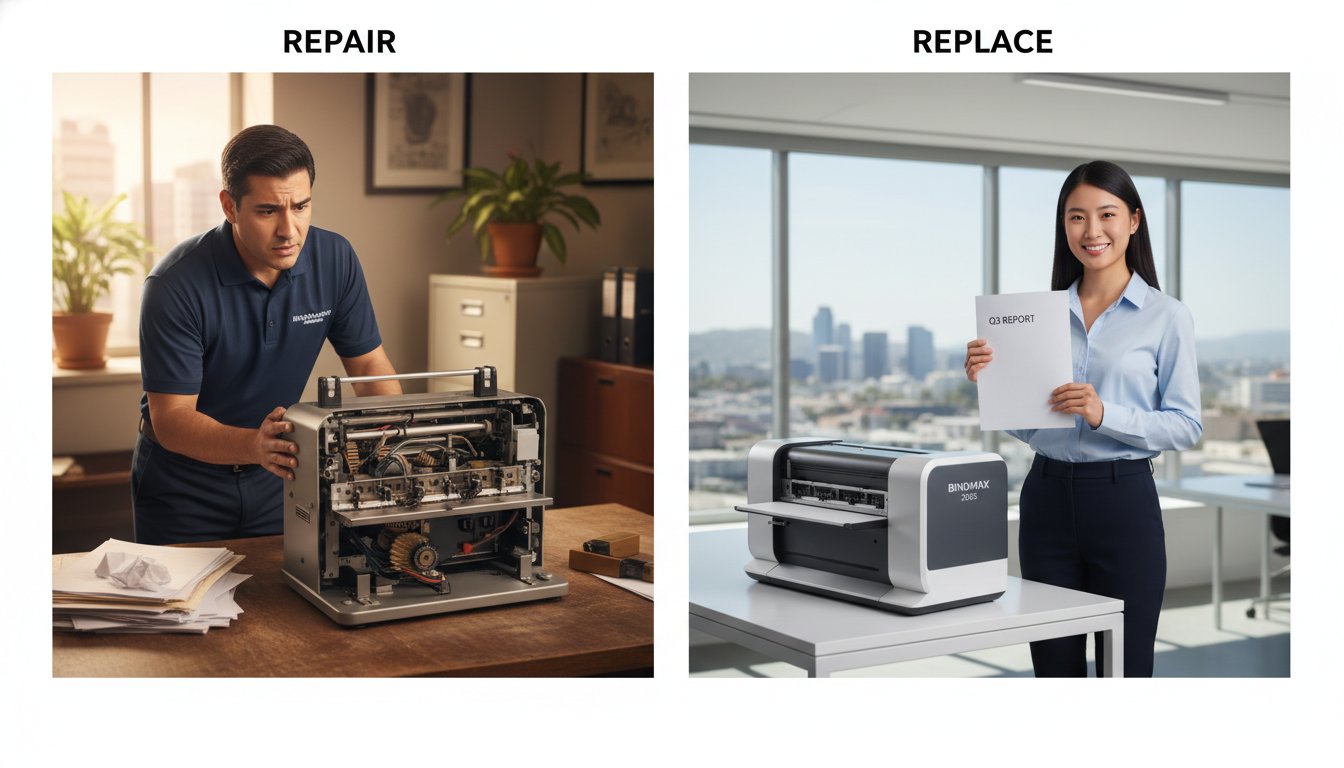
Did you know the average employee loses 22 minutes of productive time every day because of equipment malfunctions? When your document finishing stops, your professional momentum follows suit. For local firms, the debate over binding machine repair vs replace San Diego often boils down to a single, stressful moment: do you call a technician or start browsing for a new Rhin-O-Tuff Onyx? It's a common dilemma where the fear of hidden shipping costs for heavy machinery often clashes with the simple desire for a reliable, modern workflow.
We understand that your reputation is tied to the tactile quality of every presentation you hand to a client. This guide provides a professional framework to help you navigate the 50/50 rule and determine when a repair is a sound investment or a temporary fix for a terminal problem. You'll learn how to evaluate the longevity of your current setup, avoid the 23% of help desk tickets caused by mechanical failures, and decide if upgrading to a high-capacity Akiles or GBC model is the most efficient path forward for your San Diego office.
Key Takeaways
- Apply the 50% rule to determine if the cost to salvage your current equipment exceeds half its market value.
- Simplify the choice of binding machine repair vs replace San Diego by comparing local on-site service speeds against the high cost of shipping heavy machinery.
- Recognize terminal symptoms like cracked internal frames or the lack of available parts for legacy GBC and Tamerica models.
- Evaluate how modern 2026 efficiency features, such as increased punching speeds and ergonomic improvements, can enhance your team's productivity.
- Follow a professional two-step framework to assess your machine's age against its expected duty cycle before committing to a fix.
Analyzing the Costs: Repair Fees vs. New Equipment Investment
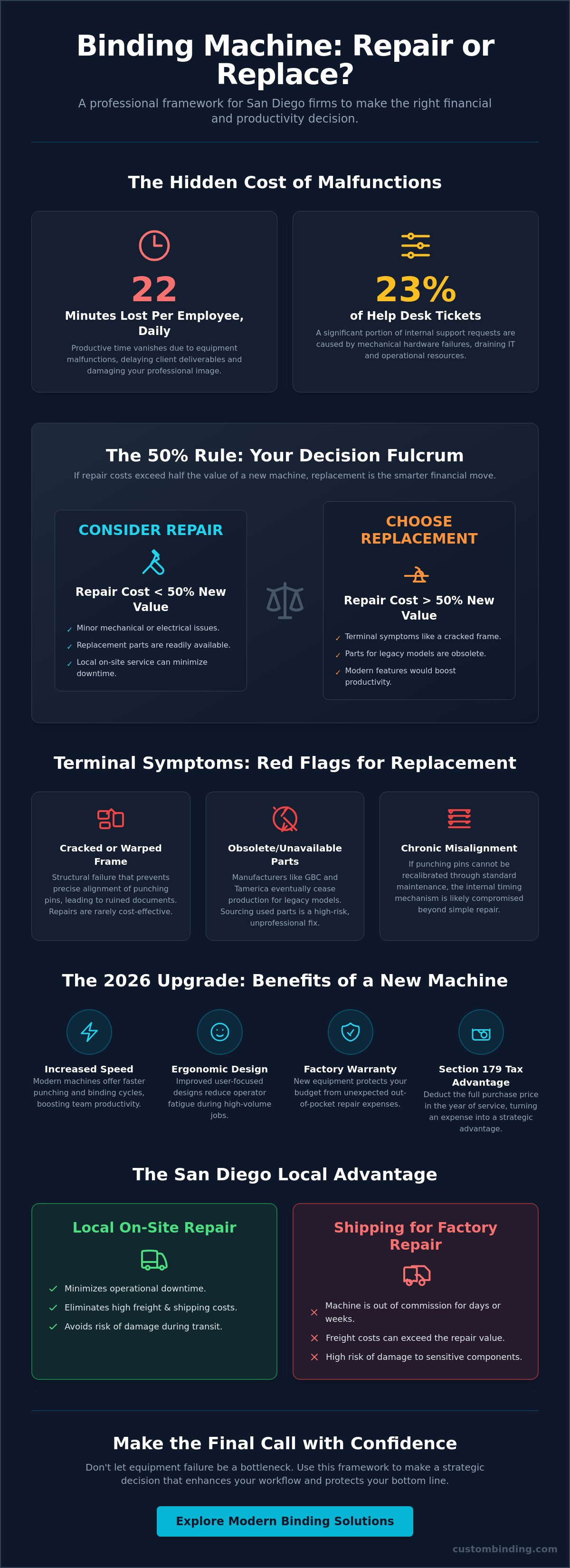
Applying a logical framework to your equipment decisions prevents emotional spending and keeps your production line moving. The most reliable industry standard is the 50% Rule. If a technician’s quote for parts and labor exceeds half the original purchase price or the current MSRP of a comparable 2026 model, replacement is usually the smarter financial move. This calculation helps San Diego organizations avoid the sunk cost fallacy, where businesses keep pouring capital into aging machines that have already reached the end of their mechanical life cycle. To understand the complexity of these machines, it helps to look at the broader context of what is bookbinding and how mechanical stress impacts various assembly methods over time.
Beyond the immediate invoice, you must factor in the cost of lost productivity. A 2026 industry report indicates that the average employee loses roughly 22 minutes of productive time daily due to equipment malfunctions. In a fast-paced San Diego legal or architectural firm, that downtime creates a ripple effect that delays client deliverables and damages your professional image. When you analyze your binding machine repair vs replace San Diego options, remember that a machine sitting in a repair shop isn't just a maintenance expense; it's a bottleneck in your professional storytelling process.
The Direct Costs of Professional Repair
Professional service involves more than just a quick fix. Most specialized technicians in the San Diego region charge a diagnostic or trip fee to assess the unit and identify the root cause of the failure. While this fee is often applied toward the final repair if you approve the work, the costs of replacement parts like punching pins, motors, or handle assemblies for older units can climb quickly. Choosing a local specialist for on-site service eliminates the freight trap. Shipping a 50lb steel binder to a distant factory depot often costs more than the repair itself and carries a high risk of transit damage to sensitive internal components.
The Investment Value of New Hardware
Investing in modern hardware like the Akiles CoilMac-M or the Rhin-O-Tuff Onyx HD7700 often provides a better long-term ROI than patching up a legacy system. New equipment comes with the security of a factory warranty, protecting your budget from out-of-pocket expenses for at least the first year. Additionally, many San Diego businesses leverage Section 179 tax incentives, which may allow you to deduct the full purchase price of qualifying equipment in the year it's placed in service. This turns a necessary purchase into a strategic tax advantage while ensuring your supply of plastic spiral coils or twin loop wire remains uninterrupted by mechanical failures. Modern 2026 models also offer superior supply compatibility, ensuring your finished documents maintain a consistent, high-value tactile experience.
Terminal Symptoms: When Your Binding Machine is Beyond Professional Repair
Identifying the exact moment a piece of equipment transitions from "reliable workhorse" to "liability" requires a keen eye for mechanical red flags. While many minor issues are fixable, structural failure is often the final word. A cracked or warped internal frame, for instance, represents a catastrophic breakdown. Because the frame maintains the precise alignment of the punching pins and die bed, any deviation results in slanted holes and ruined documents. If your internal chassis is compromised, the decision regarding binding machine repair vs replace San Diego is effectively made for you; structural repairs are rarely cost-effective or permanent.
Availability of components is another hard limit. Legacy models from brands like GBC or Tamerica eventually hit an "obsolescence wall" where the manufacturer ceases production of specific gears, motors, or circuit boards. Scouring the secondary market for used parts is a high-risk strategy that rarely meets professional standards. For organizations carrying equipment breakdown insurance, the lack of certified replacement parts often triggers a replacement claim rather than a repair attempt. Relying on "jerry-rigged" fixes in a high-volume environment isn't just inefficient; it's a safety hazard that can lead to motor overheating or electrical shorts.
Mechanical Red Flags for Coil and Wire Binders
Precision is the hallmark of a professional finish. If your punching pins are misaligned and cannot be recalibrated through standard maintenance, the internal timing of the machine is likely shot. Similarly, worn-out rollers in electric coil inserters can slip, causing friction burns on your plastic spiral coils and slowing down your assembly line. Die fatigue occurs when the sharp edges of the punching pins lose their temper and structural integrity, resulting in jagged, unprofessional holes that tear the paper rather than piercing it cleanly. When this happens, the friction increases, putting unnecessary strain on the motor and accelerating the machine's decline.
Electrical Failures in High-Volume Units
Heavy-duty electric punches rely on complex circuit boards to manage the torque required for high-capacity projects. A blown board or a malfunctioning safety sensor can render an expensive unit like a GBC CombBind C800pro completely inert. While sensors can sometimes be cleaned or replaced, intermittent electrical failures often point to deeper wiring issues that are costly to trace. If your machine frequently trips breakers or smells of ozone during a long run, it's time to stop production immediately. If you're noticing these red flags, a professional diagnostic from Custom Binding can confirm if your unit has reached its terminal point or if a simple calibration can save the investment.
The 2026 Efficiency Upgrade: Benefits of Replacing Outdated Hardware
Choosing to move beyond a failing unit isn't just about avoiding a repair bill; it's about reclaiming lost time. When evaluating binding machine repair vs replace San Diego, the decision often shifts from salvage to strategy. Older machines, particularly those manufactured before 2015, lack the motor efficiency and decibel control found in 2026 hardware. Modern electric binders are engineered for quiet operation, making them far better suited for the open-plan offices common in San Diego’s tech and financial sectors. A quieter machine reduces environmental stress while delivering a significantly higher output speed than legacy technology.
Versatility is another major driver for equipment replacement. Older setups often require dedicated units for different binding styles. Current 2026 models frequently offer multi-functional capabilities, allowing a single workstation to handle plastic spiral coils, twin loop wire, and comb binding. This consolidation saves valuable floor space and reduces the learning curve for your staff. Ergonomic improvements also play a vital role in modern design. Newer units feature neutralized handle weights and intuitive foot-pedal placements that reduce operator fatigue, a critical factor for high-volume San Diego print shops managing tight deadlines.
Productivity Gains with Modern Punching Systems
Modern high-performance units, such as the Rhin-O-Tuff Onyx HD7700, have redefined sheet capacity standards. While an older machine might struggle with 15 sheets of 20lb bond, a 2026 heavy-duty punch can often process up to 55 sheets in a single cycle. This leap in performance drastically shortens production windows. Consider these productivity features found in modern hardware:
- Interchangeable Die Systems: Swap from coil to wire in seconds, effectively future-proofing your investment against changing client preferences.
- Precision Margin Controls: Eliminate the "trial and error" waste of ruined covers by using micro-adjustable side guides.
- Advanced Cooling: Industrial-grade motors in models like the Tamerica Optimus-450 allow for continuous run times without the thermal shutdowns common in older consumer-grade units.
Professional Aesthetics and Brand Image
The tactile experience of your document is a direct reflection of your brand’s attention to detail. Documents bound on precision-calibrated 2026 equipment feature crisp, clean punches without the burrs or "half-moons" caused by dull, fatigued dies. When you pair a perfectly punched document with high-quality materials like Regency Composition Covers or clear acetate covers, you signal a commitment to quality that "jerry-rigged" repairs simply cannot replicate. Investing in new hardware ensures that every legal report or financial proposal you deliver maintains a consistent, high-value aesthetic that supports your professional reputation.
San Diego Local Advantage: On-Site Repair Logistics and Downtime
Shipping a 50lb industrial binder to a distant factory depot creates a logistical nightmare known as the "Freight Trap." For many organizations, the cost of palletizing and freighting heavy equipment often rivals the price of the repair itself. This financial burden, combined with the risk of transit damage to sensitive internal gears, makes the decision of binding machine repair vs replace San Diego much simpler when local expertise is available. By choosing on-site service, you keep your equipment within your secure facility, avoiding the 4 to 6 week lead times typical of out-of-state factory depots.
Local diagnostics provide an immediate advantage by eliminating the "blind quote" process. When you ship a machine away, you're often at the mercy of a distant technician's schedule and pricing. In contrast, a local specialist can evaluate your machine in its actual working environment, identifying if the issue is a simple calibration error or a terminal mechanical failure. This transparency ensures that you only pay for the necessary work without the added premium of round-trip shipping costs and potential insurance claims for damage incurred during transit.
Eliminating Shipping Risks and Costs
The physical movement of heavy-duty binding machinery carries inherent risks. Even when properly crated, the vibrations and impacts of long-haul trucking can misalign the very punching pins you're trying to fix. Local on-site diagnostics eliminate this variable entirely. A specialized technician can identify the root cause of your equipment downtime without the machine ever leaving your print room. This approach also maintains the security of your document finishing environment; you don't have to worry about sensitive hardware being handled by third-party carriers who don't understand the precision required for high-volume finishing.
Custom Binding’s Local Service Commitment
Reliability is the foundation of a successful professional partnership. Our team understands the unique pace of the local business climate, from the high-stakes deadlines of Downtown law firms to the rapid production cycles of Sorrento Valley tech offices. We focus on getting your production line back into operation within 24 to 48 hours, a timeline that factory depots simply cannot match. You can learn more about Our On-Site Repair Process for San Diego Businesses to see how we minimize friction in your workflow.
Beyond emergency fixes, we offer proactive maintenance plans designed for high-volume users who can't afford a single day of downtime. This local presence means you have direct access to specialists who prioritize your organization’s uptime and document quality. If you're currently facing a mechanical bottleneck, request a professional on-site diagnostic to determine the most cost-effective path for your equipment.
Making the Final Call: Custom Binding’s Professional Recommendation
Finalizing your choice requires more than just a glance at a spreadsheet; it demands a strategic look at your document production's future. While we've discussed the 50% rule as a financial benchmark, the ultimate decision on binding machine repair vs replace San Diego often rests on the machine's duty cycle. A heavy-duty unit built for 24/7 operation has a different lifecycle than a desktop model used for occasional reports. To make an informed choice, follow this professional four-step evaluation process:
- Step 1: Get a professional diagnostic. Contact a local San Diego technician to identify the root cause. A simple sensor cleaning is a minor fix, but a burnt-out motor on an aging unit is a clear signal to move on.
- Step 2: Evaluate age versus duty cycle. If your machine is over seven years old and runs daily, its internal components have likely reached their fatigue limit.
- Step 3: Compare the quote to a 2026 model. Use the repair estimate as a down payment comparison. If the repair costs 40% of a new machine but only extends the life by one year, the ROI isn't there.
- Step 4: Assess your volume growth. If your organization has grown, your old machine might be the bottleneck. Upgrading to a high-capacity unit like the GBC CombBind C800pro can save dozens of labor hours annually.
When to Repair (The "Fix It" Scenario)
Repair is the logical path when the machine’s core structural integrity remains intact. High-end equipment, such as professional Akiles units, is often designed with modular components that make spring replacements or simple mechanical jam clearing a cost-effective solution. If your machine is under five years old and has seen low-to-moderate usage, a professional calibration can often restore it to factory-new performance. This is especially true if you've invested in expensive custom dies that are still in perfect condition and compatible with your current chassis. Keeping a well-maintained machine in service supports sustainability and maximizes your initial capital investment.
When to Replace (The "Upgrade" Scenario)
Replacement becomes the only professional choice when a machine becomes a recurring source of friction. If a unit requires its third major repair in a two-year window, it's no longer a reliable tool; it's a liability. Moving from a manual punching system to a modern electric unit like the Tamerica Optimus-450 isn't just a repair avoidance strategy; it's a labor-saving upgrade that pays for itself through increased throughput. When you factor in the 23% of help desk tickets tied to mechanical failures, the case for new, warrantied hardware becomes undeniable. Don't let outdated tech compromise your professional finish. You can Browse our 2026 Binding Machine Catalog to explore modern efficiency or Request a Repair Quote to have a specialist evaluate your current equipment's viability.
Securing Your Professional Presentation for the Future
Every document your organization produces serves as a tactile representative of your brand's standards. Navigating the choice of binding machine repair vs replace San Diego requires balancing immediate costs against long-term operational efficiency. By applying the 50% rule and recognizing the terminal signs of structural fatigue, you can prevent mechanical bottlenecks before they disrupt your workflow. Whether you choose to salvage a high-end Akiles unit or upgrade to a modern Rhin-O-Tuff system, your goal remains the same: a polished, professional finish that instills confidence in your clients.
Custom Binding has served the San Diego business community since 1988, acting as an authorized dealer for all major binding brands. We provide expert on-site service for GBC, Rhin-O-Tuff, and Akiles equipment, ensuring your production line stays local and protected from the risks of freight shipping. Our specialists are ready to help you evaluate your equipment's current viability and future potential. Get a Professional Repair vs. Replace Consultation today to ensure your finishing process is as precise as the work it contains. We're here to help you maintain a seamless, high-quality presentation environment.
Frequently Asked Questions
How much does it typically cost to repair a binding machine in San Diego?
Repair costs vary based on the machine's complexity and the specific parts required for the fix. Most local service providers charge a diagnostic or trip fee to assess the unit, which is often applied toward the final labor cost if you approve the work. While annual on-site service contracts are available for a flat fee, per-call rates depend on whether your unit requires a simple calibration or a significant motor replacement.
Can I fix my binding machine myself or do I need a professional?
Minor maintenance tasks like clearing paper jams or emptying the waste tray are standard user responsibilities. However, internal mechanical failures or electrical issues require a specialist's touch. Attempting a DIY fix on high-precision units like a Rhin-O-Tuff Onyx HD7700 can lead to misaligned punching pins or voided warranties. Professional intervention is the only way to ensure your equipment maintains the precise calibration needed for a high-value document finish.
Which binding machine brands are the easiest to get parts for in 2026?
Major industry brands like Akiles, Rhin-O-Tuff, and GBC maintain the most reliable parts availability in 2026. These manufacturers support their heavy-duty models with consistent supply chains for punching dies, motors, and circuit boards. Choosing these established names simplifies the binding machine repair vs replace San Diego decision because you aren't forced to replace a unit simply because a single gear has been discontinued by the manufacturer.
How long should a professional-grade binding machine last?
A well-maintained, professional-grade machine typically lasts between 7 to 10 years depending on your production volume. Heavy-duty electric punches often exceed this lifespan when they are supported by a consistent preventative maintenance plan. Regular lubrication and die sharpening are essential to prevent the motor strain that leads to premature mechanical failure. Machines in high-volume San Diego print shops may reach their duty cycle limits faster than those in low-usage office environments.
Does Custom Binding Products offer loaner machines during repairs?
Businesses should inquire about loaner availability when scheduling their on-site diagnostic. While our on-site repair process is designed to minimize downtime by fixing the unit directly in your facility, complex mechanical overhauls may require more time. We prioritize rapid response and efficient service to ensure your document finishing schedule remains uninterrupted. If a repair is expected to take longer than 48 hours, we can discuss the best temporary solutions for your specific workflow.
Is it worth repairing a plastic comb binder or should I switch to coil?
The decision depends on your desired document aesthetic and current volume requirements. If your GBC CombBind C800pro needs a minor mechanical adjustment, repair is a highly cost-effective path. However, if your firm is moving toward the modern, durable look of plastic spiral binding coils, investing in a new 2026 coil binder provides better long-term value. Replacing outdated technology allows you to adopt more efficient punching systems that can save significant labor costs over time.
What is the turnaround time for on-site repair in San Diego?
Most local service calls in the San Diego area are addressed within 24 to 48 business hours. On-site diagnostics allow a technician to identify the problem immediately, often completing the repair in a single visit if common parts are in stock. This local response is significantly faster than the 4 to 6 week lead times typical of shipping a machine to an out-of-state factory depot. Rapid turnaround ensures your production line stays active and your deadlines are met.
Will a new machine work with my existing binding supplies?
Most modern 2026 machines maintain industry-standard pitch patterns to ensure compatibility with your current inventory. For instance, switching from an older manual punch to a new Akiles CoilMac-M won't require you to replace your existing stock of 4:1 pitch plastic coils. Always verify the specific punch pattern and hole shape of a new machine before purchase. This ensures a seamless transition for your inventory of twin loop wire, combs, or Regency Composition Covers.